

Europe
Top 10 Countries for a Europe Work Permit from UAE in 2027
Top 10 Countries for a Europe Work Permit from UAE in 2027 Salaries, Residency and Citizenship Compared 2027 planning guide | Research checked: 27 October
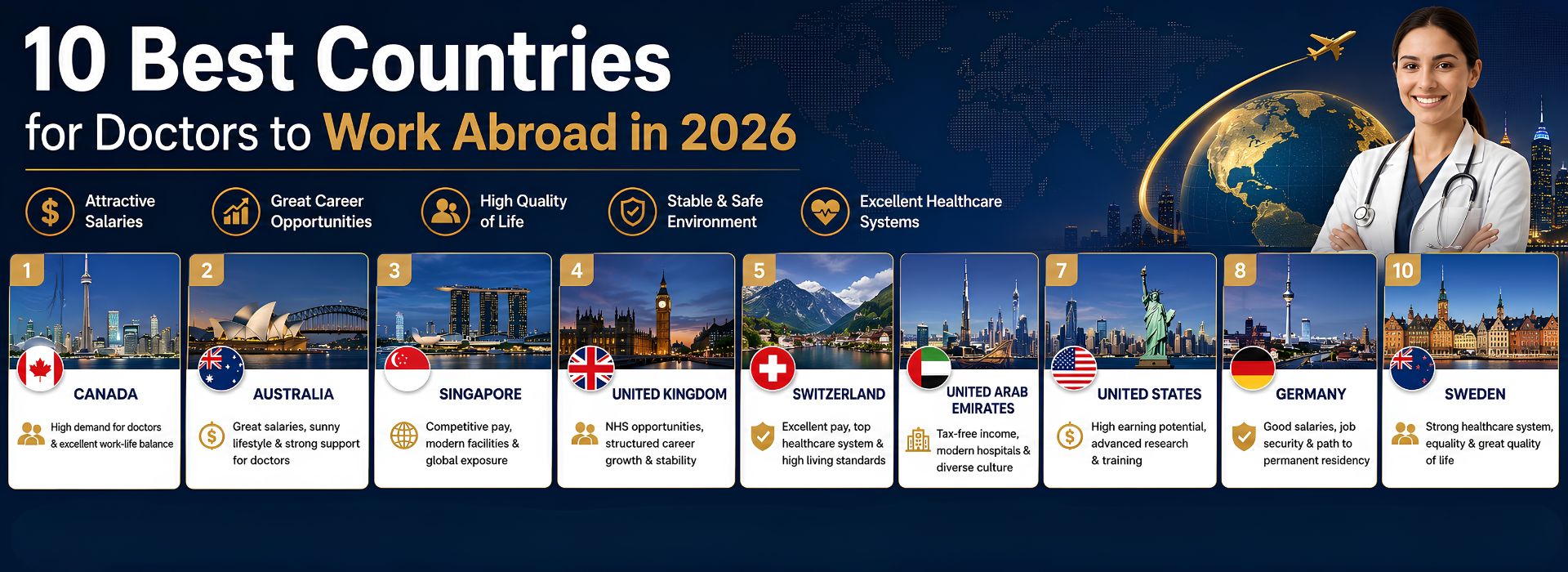
The best countries for doctors to work abroad in 2026 include Australia, Canada, the United Kingdom, New Zealand, Ireland, Germany, the United States, Switzerland, Norway and France.
These destinations provide different combinations of medical workforce demand, competitive earnings, professional training, employer-sponsored visas and long-term residence opportunities.
Global demand remains significant. The World Health Organization projects a worldwide shortfall of approximately 11 million health workers by 2030. Meanwhile, ageing populations are increasing demand for primary care, chronic-disease management, emergency medicine, mental healthcare and specialist treatment.
Internationally trained doctors already play a major role in developed healthcare systems. More than 600,000 foreign-trained doctors were practising across OECD countries in 2023, representing an increase of approximately 62% from 2010.
However, doctors cannot normally begin practising abroad based only on a job offer or immigration visa. Medicine is a regulated profession, and applicants usually need to complete a separate medical registration or licensing process.
Important: Medical registration, employment and immigration are three separate processes. Eligibility for one does not guarantee approval of the others.
The best country depends on the doctor’s qualification, specialty, experience, language ability, registration eligibility and long-term objectives.
| Country | Indicative Salary Benchmark | Medical Registration Authority | Main Immigration Route | Long-Term Residence |
|---|---|---|---|---|
| Australia | Around AUD 127,000 annualised median for GPs and resident medical officers | Medical Board of Australia through Ahpra | Employer sponsorship, skilled or regional migration | Strong |
| Canada | Approximately CAD 90,826–435,240 | Provincial or territorial medical regulator | Employer work permit, Express Entry or PNP | Strong |
| United Kingdom | Grade-based; published healthcare going rates start from junior grades and exceed £100,000 for consultants | General Medical Council | Health and Care Worker Visa | Available |
| New Zealand | GPs commonly NZD 133,000–267,000; specialist base salaries may be higher | Medical Council of New Zealand | AEWV and eligible residence pathways | Strong |
| Ireland | HSE salary scales vary by grade; public consultant scales commonly exceed €160,000 | Medical Council of Ireland | Critical Skills or General Employment Permit | Strong |
| Germany | Around €89,400 median annualised earnings | State licensing authority | Qualified-professional visa or EU Blue Card | Available |
| United States | Median salary of at least USD 239,200 for physicians and surgeons | State medical board after ECFMG pathway | J-1, H-1B, O-1 or employment-based route | Available |
| Switzerland | Highly variable by canton, specialty and employment model | MEBEKO and MedReg | Employer-supported cantonal permit | Available but restrictive |
| Norway | Around NOK 1.11 million for generalists and NOK 1.32 million for specialists | Norwegian Directorate of Health | Skilled Worker Residence Permit | Available |
| France | Public and private earnings vary by grade and practice model | French Medical Council and relevant authorisation bodies | Salaried-worker or eligible talent route | Available |
Salary figures are indicative gross benchmarks. Actual income depends on seniority, specialty, location, working hours, on-call duties, private practice, allowances and employment terms.
Several structural trends are increasing demand for doctors worldwide.
By 2030, approximately one in six people worldwide will be aged 60 or older. Older populations generally require more primary care, chronic-disease treatment, rehabilitation and specialist medical support.
The prevalence of diabetes, cardiovascular disease, cancer, respiratory illness and age-related conditions is increasing demand for long-term medical management.
Many countries have greater shortages outside major cities. Regional hospitals and community health providers may therefore offer additional recruitment or immigration opportunities.
A significant portion of the medical workforce is approaching retirement in several countries, increasing replacement demand.
Psychiatrists, mental-health physicians and related specialists are needed as healthcare systems expand mental-health services.
Foreign-trained doctors represent more than 40% of the medical workforce in countries including New Zealand, Ireland, Norway and Switzerland.
Demand varies by country and region, but opportunities frequently arise in:
An occupation being in demand does not remove the need for medical registration, specialist recognition or employer sponsorship.
Australia is one of the leading destinations for international medical graduates seeking hospital, general practice, specialist or regional healthcare careers.
Opportunities exist across:
Jobs and Skills Australia reports median full-time earnings of AUD 2,446 per week for general practitioners and resident medical officers. This is approximately AUD 127,000 annually before tax. Specialist and private-practice earnings can be considerably higher.
Doctors must register with the Medical Board of Australia through Ahpra.
Possible registration pathways include:
The correct pathway depends on where the doctor qualified, completed training and currently holds registration.
International specialists may need assessment by the relevant Australian specialist medical college. Ahpra and the Medical Board have also introduced expedited pathways for selected internationally qualified specialists.
Applicants must meet the applicable English-language registration standard. Accepted evidence can include approved English tests or other permitted pathways.
Potential routes include:
Many medical occupations appear on Australia’s skilled occupation instruments, including the Core Skills Occupation List used for applicable employer-sponsored pathways. The correct visa depends on the specific medical occupation and applicant profile.
Doctors seeking:
Canada has ongoing demand for family physicians, general practitioners and specialists, particularly in rural, northern and underserved communities.
Doctors may work through:
Canada’s Job Bank reports annual medical-doctor earnings ranging from approximately CAD 90,826 to CAD 435,240. Income varies significantly because many Canadian physicians are paid through fee-for-service, alternative payment plans or blended models.
Medical licensing is handled by the regulator in the province or territory where the doctor intends to practise.
International medical graduates may need:
The Medical Council of Canada provides information and credential services, but the final authority to issue a licence rests with the provincial or territorial regulator.
Potential immigration routes include:
Healthcare occupations remain included in Canada’s Express Entry category-based selection system. Canada also introduced a dedicated category for doctors with at least one year of eligible Canadian medical work experience during the preceding three years.
This dedicated physician category should not be interpreted as an automatic offshore pathway for every foreign-trained doctor. Applicants must meet the specific Canadian-experience requirement.
Doctors interested in:
The UK remains a major destination for international doctors because of the scale of the National Health Service and its established international recruitment system.
Doctors are recruited across:
Official healthcare occupation going rates vary by position. Published figures include approximately £34,500 for Foundation Year 1-equivalent posts and more than £105,000 for consultant-equivalent positions. Actual NHS pay can include supplements for additional hours, on-call work and location.
Updated medical and dental pay arrangements took effect from April 1, 2026.
Doctors must obtain registration with the General Medical Council before practising.
An international medical graduate may qualify through:
The GMC first assesses whether the applicant holds an acceptable overseas medical qualification.
Applicants relying on PLAB for full registration generally need to have passed both parts within the accepted period and completed an acceptable internship.
A qualifying doctor may apply for the Health and Care Worker Visa after receiving an eligible offer from an approved sponsor.
The applicant normally needs:
The Health and Care Worker route provides reduced visa fees and exemption from the Immigration Health Surcharge for qualifying applicants and family members.
Eligible visa holders may later qualify for Indefinite Leave to Remain after meeting the required residence and immigration conditions.
Doctors seeking:
New Zealand relies heavily on internationally trained doctors and provides opportunities across public hospitals, general practices and regional healthcare.
Common employment areas include:
General practitioners commonly earn approximately NZD 133,000–267,000 annually. Current specialist vacancies within Health New Zealand show base salary ranges of approximately NZD 185,380–267,980, before additional benefits or allowances.
Doctors must register with the Medical Council of New Zealand.
Possible pathways include:
Most non-specialist pathways require the applicant to secure an appropriate New Zealand medical position before registration can be completed.
Doctors granted provisional registration are generally required to work under approved supervision.
Possible routes include:
Eligibility depends on the role, registration, employment offer, salary and current immigration instructions. New Zealand’s skilled-residence framework includes Green List and Skilled Migrant Category options.
Doctors interested in:
Ireland offers opportunities within the Health Service Executive, public hospitals, private healthcare and community medical services.
Doctors are recruited in areas including:
Ireland’s HSE publishes national salary scales for non-consultant hospital doctors and consultants. Rates vary by grade, contract and incremental point, with public consultant scales generally exceeding €160,000 annually.
Doctors must register with the Medical Council of Ireland before practising.
The appropriate registration division may depend on whether the doctor is entering:
International applicants must provide evidence of their medical education, internship, professional standing and English-language ability where required.
Medical practitioners are included on Ireland’s Critical Skills Occupations List, updated with effect from May 13, 2026.
Eligible doctors may explore:
The Critical Skills Employment Permit generally requires an eligible occupation, qualifying salary and employment offer of at least two years. It can support immediate family reunification and later progression to Stamp 4 permission when the relevant conditions are satisfied.
Doctors seeking:
Germany has strong demand across hospitals, medical practices and regional health services.
Opportunities can arise in:
Germany’s Federal Employment Agency reports median gross earnings of approximately €7,450 per month for doctors, equivalent to around €89,400 annually. Earnings vary by hospital agreement, specialty, seniority and on-call duties.
Doctors need an Approbation, Germany’s unrestricted medical licence, before independently practising medicine.
The recognition authority assesses:
Applicants usually need general German proficiency, commonly at B2 level, and may also have to pass a medical specialist-language examination.
Where substantial differences are identified, the applicant may need to pass a knowledge examination.
Potential routes include:
A doctor normally needs recognised qualifications, professional permission and a suitable job offer before receiving a qualified-employment residence permit.
Eligible doctors can later pursue a settlement permit. The qualifying period depends on the residence category, language ability and contribution history.
Doctors who:
The United States offers some of the world’s highest physician salaries and extensive specialist training.
Doctors work across:
The US Bureau of Labor Statistics reports a median annual wage of at least USD 239,200 for physicians and surgeons. Actual earnings vary considerably by specialty, location, employment structure and working hours.
International medical graduates normally need ECFMG certification before entering an accredited US residency or fellowship programme.
The pathway generally involves:
ECFMG certification permits an IMG to enter accredited graduate medical training but does not guarantee a residency position.
Requirements are updated by application cycle. Applicants should use the current ECFMG Pathways guidance when planning examinations and Match participation.
Possible categories include:
J-1 physicians may be subject to a two-year home-residence requirement unless they qualify for a waiver such as the Conrad 30 programme.
Doctors willing to provide full-time clinical service in designated shortage areas may qualify for a physician National Interest Waiver if all requirements are met.
Doctors prioritising:
The US pathway is generally longer and more examination-intensive than many other destinations.
Switzerland offers advanced hospitals, high healthcare standards and attractive professional conditions.
International doctors work in:
However, access is significantly more restrictive for applicants who are not citizens of Switzerland, the EU or EFTA.
Foreign medical qualifications are assessed through MEBEKO, part of the Swiss Federal Office of Public Health.
Doctors may need:
Registration in MedReg and evidence of the appropriate language skills are required before practising.
For non-EU/EFTA nationals:
Switzerland has a high proportion of foreign-trained doctors, but qualification recognition does not guarantee that a non-EU doctor will receive a work permit.
Settlement-permit eligibility depends on nationality, residence history, canton and integration. Ordinary naturalisation generally requires at least 10 years of qualifying residence and possession of a settlement permit.
Highly qualified doctors who have:
Norway offers careers across public hospitals, municipal medicine, general practice and regional health services.
Demand can be particularly relevant in:
Official Norwegian salary data reports average monthly earnings of approximately:
This is equivalent to approximately NOK 1.11 million and NOK 1.32 million annually.
Doctors must obtain authorisation from the Norwegian Directorate of Health.
Applicants educated outside the EU or EEA may need:
Applicants trained outside the EU or EEA generally need Norwegian at CEFR B2 level or equivalent proficiency in Norwegian, Swedish or Danish.
A doctor normally needs:
Eligible skilled workers may apply for permanent residence after three years, subject to residence, language and other requirements. Family members can usually apply for family immigration.
For permanent residence applications submitted after September 1, 2025, applicants generally need to meet updated oral Norwegian and social-studies requirements.
Doctors willing to:
France provides careers across public hospitals, private clinics, specialist institutions and regional medical services.
Opportunities may arise in:
Doctors must obtain the necessary authorisation and register with the French Medical Council before practising.
The process depends heavily on where the medical qualification was obtained.
Doctors with eligible European qualifications may qualify through the applicable recognition framework.
Doctors with qualifications obtained outside the EU generally require prior ministerial authorisation before registration.
France has also reformed the knowledge-verification and provisional-authorisation framework for practitioners holding non-EU medical qualifications.
Applicants must normally demonstrate sufficient French-language ability for safe medical practice and patient communication.
A doctor recruited by a French hospital or healthcare organisation may need:
France’s official visa guidance confirms that medical professions are regulated and that foreign practitioners must satisfy the professional conditions attached to their occupation.
Eligible non-EU nationals may qualify for EU long-term resident status after five years of lawful and continuous residence, subject to income, integration and other requirements.
Doctors who:
The United States, Switzerland, Australia and Canada can provide high earning potential.
However, salary alone should not determine the destination.
Doctors should compare:
A country with a lower gross salary may provide better savings, working conditions or residence opportunities.
No country is universally easy because medical licensing depends on the applicant’s education, internship, postgraduate training and registration history.
Broadly:
Confirm whether your university and qualification are accepted by the relevant medical regulator.
Determine whether you need:
Demand and registration processes may differ between:
English-speaking destinations may require IELTS, OET or accepted educational evidence.
European destinations may require:
Clinical language standards are often stricter than ordinary immigration-language requirements.
Check whether the route requires:
Review when and how a work visa may lead to:
Check:
Requirements vary, but applicants may need:
Documents may need direct primary-source verification.
Evaluate:
Identify the official medical board or council responsible for registration.
Arrange primary-source verification and submit the required academic and professional records.
Take the required English or local-language test.
Where required, complete examinations such as:
Obtain provisional, general, specialist or supervised registration as applicable.
Apply through:
Use the immigration route that matches the employment offer and registration status.
These may include:
Track residence, employment, language, tax and professional requirements from the beginning.
A DHA, DOH or MOHAP licence can support the applicant’s professional history, but it does not normally replace the destination country’s registration process.
Some employers consider only candidates who are already registered or eligible for a defined registration pathway.
Licensing time, examination costs, taxation and living expenses can materially affect the outcome.
General practitioners, resident doctors and specialists may be classified differently.
Employment references, registration records and application forms should show consistent dates and duties.
Being licensed as a doctor does not automatically provide recognition as a consultant or specialist.
No legitimate consultant should promise a guaranteed hospital job, medical licence, visa or permanent residence.
The Global Axis Immigration Consultants assists eligible healthcare professionals in Dubai, Abu Dhabi and across the UAE with immigration pathway planning.
Our support may include:
Medical-registration and employment decisions are made by the relevant regulators and employers. The Global Axis does not guarantee a medical licence, employment offer, visa or permanent residence.
Speak with The Global Axis Immigration Consultants in Dubai to compare work visa, skilled migration and long-term residence options based on your medical qualifications, experience and family goals.
Book your eligibility assessment today.
Australia, Canada, the UK, New Zealand, Ireland, Germany, the US, Switzerland, Norway and France are among the leading options. The right destination depends on medical registration, specialty demand, language ability, salary, visa eligibility and settlement goals.
The United States, Switzerland, Australia and Canada can provide high salaries. Earnings vary by specialty, experience, working hours, private practice and location, so gross salary should be compared with taxation and living costs.
Demand is significant in Australia, Canada, the UK, New Zealand, Ireland, Germany and several regional European markets. Shortages are often greater in general practice, psychiatry, emergency medicine and rural healthcare.
Yes. Australia, Canada, New Zealand, the UK, Ireland, Germany and Norway provide potential long-term residence pathways. Eligibility depends on the visa, employment history, residence duration, language ability and other conditions.
Some points-tested immigration pathways may initially allow a doctor to submit an expression of interest without an employer. However, most medical registration and work-permit routes eventually require an approved position or supervised practice arrangement.
A UAE licence demonstrates professional registration and may support credential verification. It does not normally give an automatic right to practise in another country.
Recognition depends on the university, qualification, internship and regulator. Indian-trained doctors may pursue registration in countries including the UK, Australia, New Zealand, Ireland, Germany, Canada and the US, but examinations or additional training may be required.
English-speaking regulators may require IELTS, OET or other accepted evidence. Requirements and scores differ by country and registration pathway.
The UK is often considered relatively structured because of its GMC and PLAB process. However, eligibility still depends on an acceptable medical qualification, internship, English ability and registration evidence.
Some doctors may qualify through the Competent Authority or specialist pathways and may not follow the standard AMC examination route. The correct pathway depends on previous training and registration.
Yes, where they qualify for an Express Entry-managed programme. However, immigration approval does not provide a provincial medical licence. The dedicated physician category also has specific Canadian-work-experience requirements.
Yes. NHS trusts and approved private healthcare organisations can sponsor eligible doctors through the Health and Care Worker Visa.
Many medical roles can qualify under New Zealand’s skilled-residence framework, subject to the current Green List role, registration, employment and immigration requirements.
Medical practitioners are included on Ireland’s Critical Skills Occupations List. The position, salary, contract and applicant must still meet the permit conditions.
Yes. Doctors generally need at least B2 general German and may need to pass a specialist medical-language examination.
Yes, but most international medical graduates need ECFMG certification, USMLE examinations, a residency position and a state medical licence.
Most qualifying skilled-worker and residence routes allow eligible spouses and dependent children. Family work rights, education and healthcare benefits depend on the destination and visa category.
It can take several months or longer. The timeline depends on document verification, examinations, language requirements, regulator processing and whether additional training is required.
No. Employers decide recruitment, medical councils decide registration and government authorities decide visas. No consultant can legitimately guarantee these outcomes.
The first step is to compare medical-registration eligibility and immigration eligibility together. Choosing a country before checking both can lead to unnecessary expense and delays.
Top 10 Countries for a Europe Work Permit from UAE in 2027 Salaries, Residency and Citizenship Compared 2027 planning guide | Research checked: 27 October
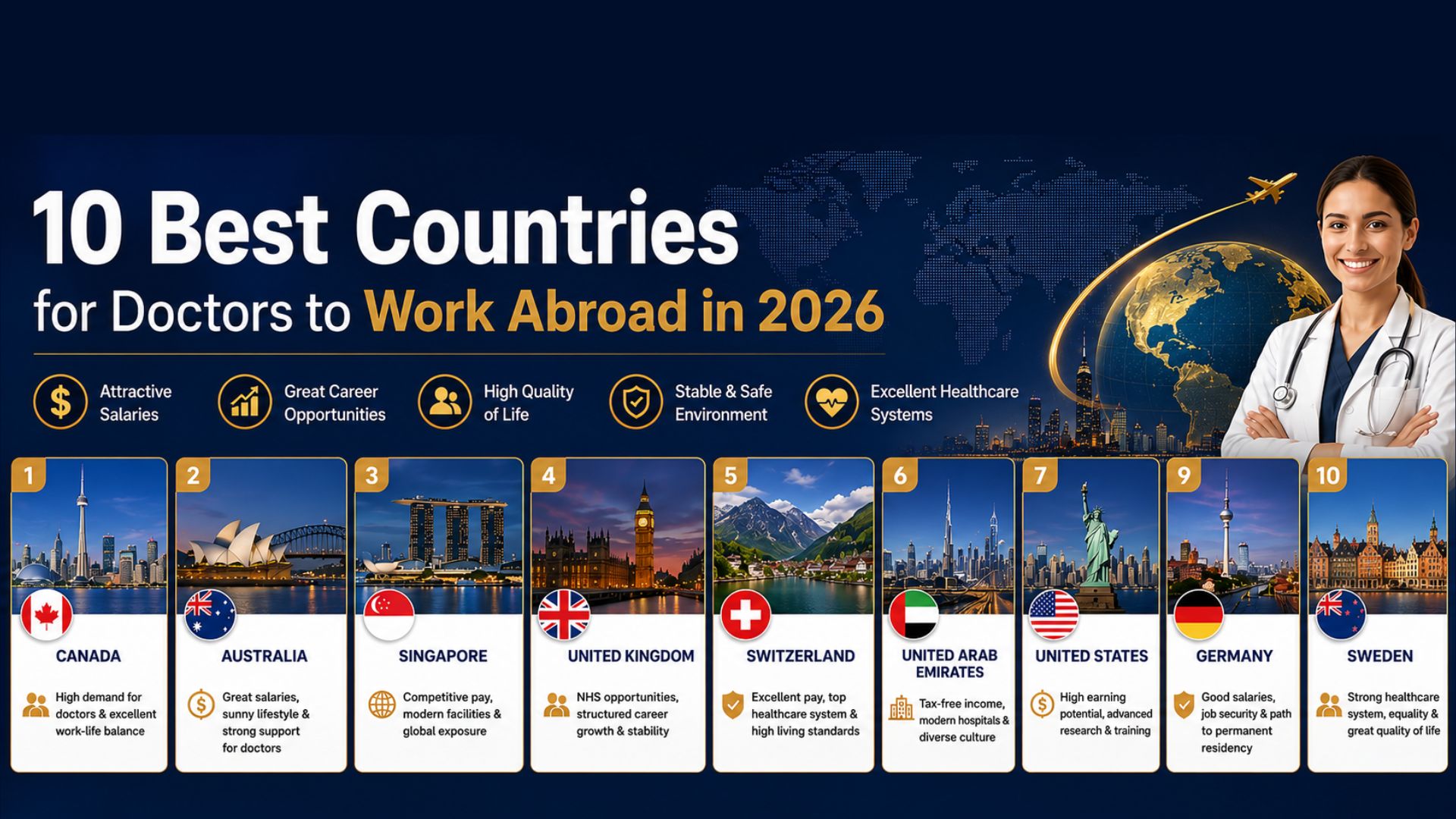
10 Best Countries for Doctors to Work Abroad in 2026 The best countries for doctors to work abroad in 2026 include Australia, Canada, the United

Indian Passport Holders in UAE: Skilled Migration and Work Permit Options in 2026 Indian Passport Holders in UAE: Skilled Migration and Work Permit Options in


Contact us today to address all your immigration related inquiries and take the first step toward achieving your global aspirations
Contact us today to address all your immigration related inquiries and take the first step toward achieving your global aspirations