The Global Axis Immigration Services LLC | 2027 planning guide | Research checked: 14 November 2026
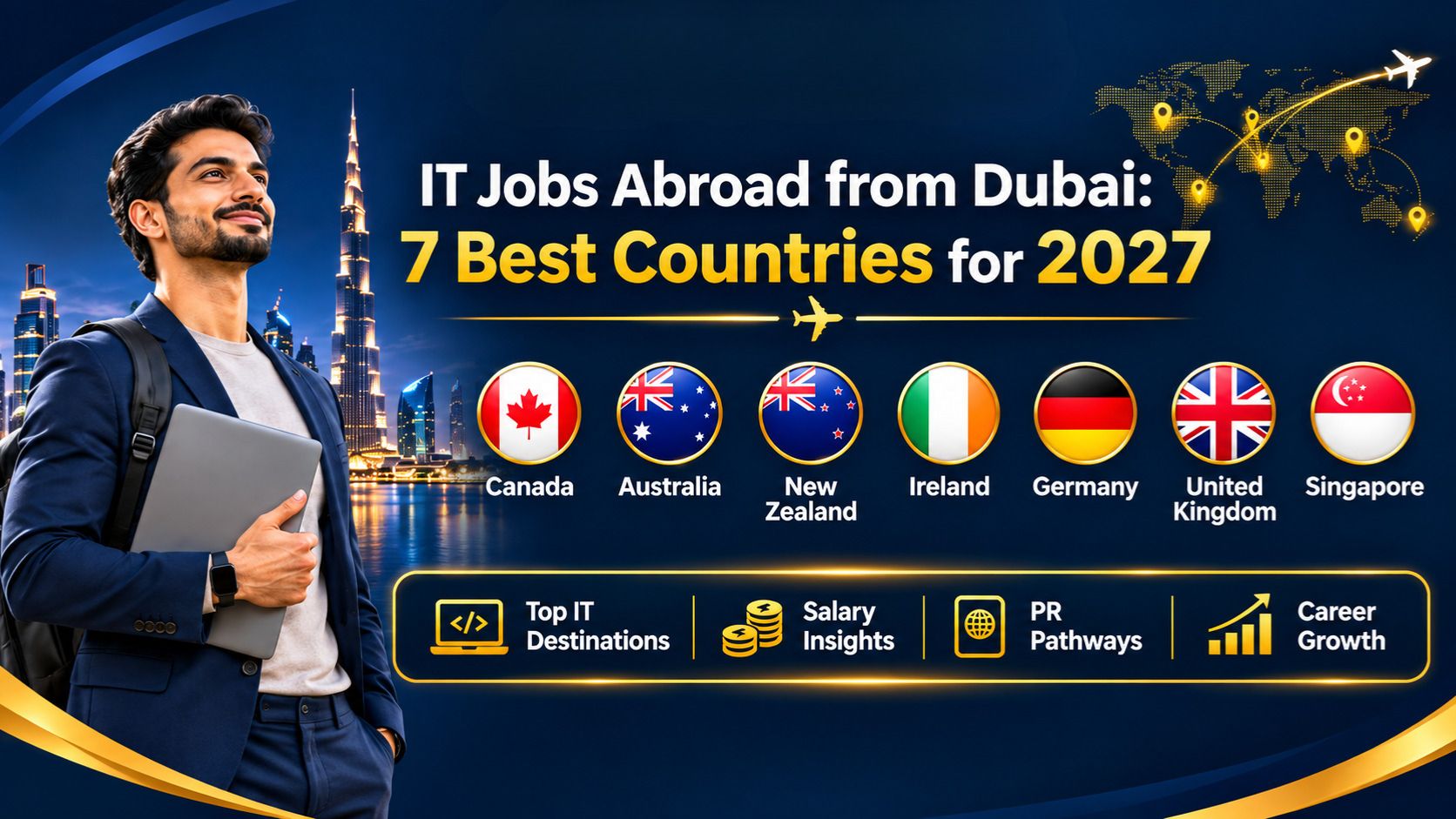
Looking for IT jobs abroad from Dubai in 2027? Australia, Canada, New Zealand, Germany, Ireland, the Netherlands and the United Kingdom offer different opportunities for technology professionals. Your strongest option depends on your technical experience, qualifications, language ability, job offer and family plans.
Can an IT professional move abroad from the UAE and obtain permanent residence? Yes, where the relevant immigration requirements are met. Australia and Canada have pathways that can grant permanent residence at approval. New Zealand offers residence for qualifying applicants, while European destinations generally require qualifying residence before a later settlement application.
This guide compares technology roles, published salary ranges, residence opportunities and family permissions. It also explains how to organise your application through The Global Axis in Dubai.
Planning for 2027: Immigration rules below reflect the information available on the research date. Salary figures are published benchmarks, not guaranteed 2027 offers. Recheck the official requirements before applying.
Quick country comparison
These seven destinations were selected for their combination of technology employment routes, skilled migration options and family provisions. This is an editorial shortlist; the order is not a government ranking or a measure of how easily a visa will be approved.
| Country | Technology roles to investigate | Main route to investigate | Longer-term residence opportunity |
|---|
| Australia | Data engineering, cloud, cybersecurity and software development | Skilled Independent 189, Skilled Nominated 190 or an eligible employer-sponsored route | 189 and 190 are permanent visas; regional 491 is provisional and has a separate potential PR pathway |
| Canada | Cybersecurity and software development; assess each occupation separately | Express Entry or an appropriate Provincial Nominee Program | Permanent residence after selection, application and approval |
| New Zealand | Eligible software engineering, ICT security and ICT project management roles | Green List Straight to Residence or another qualifying skilled residence pathway | Resident visa first; Permanent Resident Visa has separate requirements |
| Germany | Software engineering, IT systems and security specialisms | EU Blue Card or another suitable skilled employment permit | Eligible Blue Card holders can apply for settlement after 27 months, or 21 months with B1 German, subject to other conditions |
| Ireland | Eligible software, AI, data engineering, cloud and cybersecurity specialisms | Critical Skills Employment Permit for eligible ICT employment | Possible Stamp 4 upgrade after qualifying employment; Long Term Residency is a separate application |
| Netherlands | Software engineering, cloud and specialist ICT positions | Highly skilled migrant permit through an IND-recognised sponsor | Permanent residence normally requires five consecutive qualifying years and other conditions |
| United Kingdom | Software, cybersecurity, data and technical leadership | Skilled Worker visa through an approved sponsor | Current guidance and announced settlement reforms must both be checked for a 2027 move |
These are job-search examples, not a claim that every listed role qualifies for a priority visa. The country guides below link to the official requirements. For a broader comparison, explore The Global Axis skilled migration programmes.
In-demand IT professions and skills
The World Economic Forum’s Future of Jobs Report 2025 identifies AI and big data, networks and cybersecurity, and technological literacy among the fastest-growing skill areas in employers’ outlook to 2030.
That forecast supports investigating specialist technology careers. It does not mean every destination has a shortage in every IT occupation. Current vacancies, employer sponsorship and immigration occupation lists must be checked separately.
When researching IT jobs abroad, match your experience to specific responsibilities:
| Profession or specialism | Skills to demonstrate | Useful evidence for employers |
|---|
| Software development | Java, C#, Python, JavaScript, APIs and system design | Deployed applications, code samples and measurable delivery results |
| Cloud engineering and architecture | AWS, Azure, Google Cloud, networking and infrastructure automation | Production environments, migrations, reliability and cost improvements |
| Cybersecurity | Security operations, cloud security, incident response and governance | Security projects, relevant certifications and clearly documented responsibilities |
| Data engineering | SQL, Python, data pipelines, orchestration and cloud data platforms | Data quality, platform scale and business outcomes |
| AI and machine learning | Model development, evaluation, deployment and responsible AI practices | Production use cases and evidence beyond short training courses |
| DevOps and site reliability | CI/CD, containers, Kubernetes, observability and automation | Deployment frequency, availability and incident reduction |
| Business and systems analysis | Requirements, process design, integration and stakeholder communication | Delivered systems and documented organisational improvements |
| Technical project and delivery management | Delivery governance, budgeting, risk and cross-functional leadership | Project scope, team size, delivery outcomes and technical context |
A certificate can strengthen your profile, but employers also assess practical experience. For immigration, your actual duties must match the relevant occupation classification. A job title alone does not establish eligibility.
Salary ranges for IT jobs abroad
Use the following figures to build an initial budget. They cover different roles, locations and experience levels, so they are not a like-for-like country ranking.
All figures are in the stated local currency before tax. The sources were checked in November 2026. Recruiter guides, government wage statistics and employee salary surveys use different methods.
| Destination | Example role and market | Published pay benchmark | Source and basis |
|---|
| Australia | Data engineer, Sydney | AUD 110,000–190,000 a year | Morgan McKinley 2026 technology guide, low-to-high annual range |
| Canada | Software developer, national | CAD 30.00–76.92 an hour, with a CAD 48.08 median | Government Job Bank, wage update dated November 2025; reference period 2023–2024 |
| New Zealand | Software developer | NZD 90,000–154,000 a year | Tahatū Career Navigator, most common pay band |
| Germany | Software engineer | EUR 3,560–8,596 a month | Paylab salary survey, middle 80% of reported salaries |
| Ireland | .NET/C# developer, Dublin, 3–5 years’ experience | EUR 55,000–70,000 a year | Morgan McKinley 2026 technology guide, experience-specific annual range |
| Netherlands | Software engineer | EUR 3,743–6,802 a month | Paylab salary survey, middle 80% of reported salaries |
| United Kingdom | Software developer | GBP 30,000–75,000 a year | National Careers Service, starter-to-experienced range |
A market salary range is different from a visa salary requirement. For example, a salary within a published developer range may still fall below the amount required for an EU Blue Card, Dutch highly skilled migrant permit or a particular New Zealand Green List role.
Compare each offer using:
- Estimated take-home pay after tax and compulsory deductions.
- Rent, utilities, commuting and childcare in the actual city.
- Health cover, pension arrangements, leave and relocation assistance.
- Whether bonuses, allowances and benefits count towards the immigration salary requirement.
- Your household budget if only one partner works initially.
For UAE residents comparing IT jobs abroad, this household calculation is more useful than comparing headline salaries alone.
Seven country guides
1. Australia: points-based migration and employer sponsorship
Australia is worth assessing if you have relevant qualifications, well-documented professional experience and the potential to meet a skilled migration pathway’s requirements.
Technology applicants may need an Australian Computer Society migration skills assessment. ACS considers qualifications and relevant employment; an assessment outcome is separate from a visa decision.
For the Skilled Independent visa, subclass 189, applicants need an eligible occupation, a suitable assessment and an invitation. The minimum points threshold is 65, but reaching it does not guarantee an invitation. Age, English and other requirements also apply.
A Skilled Nominated visa, subclass 190 requires state or territory nomination. Regional 491 permission is provisional, with a separate potential permanent residence pathway.
What to check: Your occupation, assessable employment, English results, points and current state nomination criteria. Employer sponsorship is another route to assess where a suitable employer and position exist.
Explore Australia skilled migration support from Dubai.
2. Canada: Express Entry, provincial routes and recent CRS changes
Canada can suit applicants seeking a permanent residence pathway based on their overall skilled worker profile. Relevant options include Express Entry and provincial programmes whose current criteria match your circumstances.
For IT jobs abroad in Canada, identify your correct National Occupational Classification code before evaluating eligibility. Software development and cybersecurity have different codes and may receive different treatment.
Current category-based selection matters: IRCC’s published STEM category includes cybersecurity specialists, NOC 21220. It does not list every software development occupation. The category requires at least 12 months of qualifying experience in a listed occupation within the preceding three years, alongside the other applicable requirements. Check IRCC’s category-based selection page.
November 2026 update: IRCC reintroduced points for qualifying job offers in eligible high-wage occupations under a new Labour Market Integration factor. It compares the eligible offer score with the Canadian work experience score and uses the higher one. The high-wage classification depends on the occupation’s national median, not your individual salary. Use the current Express Entry scoring changes when assessing a 2027 profile.
What to check: Programme eligibility, language results, qualification assessment where required, occupation code and your current CRS calculation. Provincial nomination is competitive and province-specific.
Read about Canada skilled migration through The Global Axis.
3. New Zealand: selected ICT roles and residence pathways
New Zealand deserves attention when your experience matches an eligible role and you can secure the right offer.
The Green List pathway separates occupations into Tier 1 and Tier 2. Each role has its own requirements, which can include qualifications, registration and a specified pay rate.
The Straight to Residence Visa is available to qualifying applicants aged 55 or younger with an eligible Tier 1 job or offer from an accredited employer. English, health, character and employment conditions apply. Eligible partners and dependent children aged 24 or younger may be included.
A resident visa lets you live in New Zealand indefinitely. The Permanent Resident Visa is a later, separate application, normally after holding residence continuously for at least two years and meeting commitment and other requirements.
What to check: Your exact role on the current Green List. A general software developer salary may be below the pay needed for a particular residence route.
See New Zealand skilled migration guidance from Dubai.
4. Germany: EU Blue Card options for qualified and experienced IT specialists
Germany offers several employment routes for technology professionals. A suitable job offer is central to its IT specialist employment routes.
The EU Blue Card can be available with a qualifying recognised degree and employment meeting the applicable requirements. Some IT professionals without a formal degree can also qualify through at least three years of relevant university-level experience within the previous seven years, together with the required offer and salary.
For eligible Blue Card holders, a settlement permit can be possible after 27 months with A1 German, or 21 months with B1 German. Qualifying employment, pension contributions and other conditions remain necessary.
What to check: Qualification recognition or the experience-based alternative, contract terms and the salary threshold for the application year. German language study can widen your employment choices and support settlement planning.
For IT jobs abroad where a degree is a concern, Germany merits an individual eligibility review rather than an assumption that all routes require one.
5. Ireland: Critical Skills employment and a possible Stamp 4 upgrade
Ireland’s Critical Skills Employment Permit covers eligible ICT occupations and qualifying employment. It generally requires a job offer of at least two years and the appropriate remuneration and qualification conditions.
Check your actual specialism against the Critical Skills Occupations List. An IT-related job title alone is not enough.
Eligible permit holders can seek a Stamp 4 upgrade after 21 months of qualifying employment. Stamp 4 allows work without an employment permit under its conditions; it should not be described as automatic permanent residence.
Ireland’s Long Term Residency scheme has a separate assessment, including the required qualifying residence.
What to check: The occupation’s precise eligibility, contract duration, current salary requirements and accommodation budget. Dublin salary offers need to be assessed alongside housing costs.
Explore Ireland skilled migration assistance.
6. Netherlands: highly skilled migration through recognised employers
For many technology professionals, the Dutch highly skilled migrant route starts with an employment contract from an IND-recognised sponsor. Only a recognised employer can apply under this route.
The offer must meet the applicable income requirement and be consistent with the market rate. Requirements differ by category, so a salary advertised for a developer does not automatically qualify for sponsorship.
Under the published rules, permanent residence normally requires at least five consecutive years of valid residence, continued compliance, sufficient income and a qualifying non-temporary residence purpose. Civic integration requirements or an exemption also apply.
What to check: The employer’s recognition status, the salary category that applies to you and the contract’s fixed-pay structure. Recheck the rules and income amounts for 2027 before relying on an offer.
For IT jobs abroad in the Netherlands, targeting employers able to sponsor your particular role makes the job search more focused.
7. United Kingdom: sponsored technology employment and changing settlement plans
The Skilled Worker visa requires an eligible job with an approved sponsor, a Certificate of Sponsorship, the required pay and compliance with the other conditions, including English.
Software, cybersecurity, data and technical leadership opportunities should be evaluated against the specific occupation code and sponsor. Not every advertised technology vacancy offers sponsorship.
Settlement needs particular attention for 2027. On the research date, the Skilled Worker guide still described the possibility of settlement after five qualifying years. However, the government’s November 2026 earned settlement announcement set out a future ten-year starting point with faster routes for qualifying applicants.
The announcement also said detailed rules and operational arrangements were still to follow before implementation. A five-year settlement outcome should therefore not be promised to someone planning a new 2027 move.
What to check: Sponsorship, occupation eligibility, going-rate requirements, total visa and healthcare costs, and the settlement rules actually in force when relevant.
Family visas and benefits
Can your family join you when you take IT jobs abroad? Often yes, but eligibility, timing and work rights depend on the country and the principal applicant’s permission.
| Country and route | Family position to check |
|---|
| Australia, permanent skilled visas | Eligible family members can be included where requirements are met. Family members granted permanent residence can live, work and study under that status. |
| Canada | Eligible partners and dependent children may be included in a PR application. For temporary workers, a spouse’s open work permit has separate eligibility requirements. |
| New Zealand, Straight to Residence | An eligible partner and dependent children aged 24 or younger may be included. Family permissions on temporary work routes require a separate assessment. |
| Germany, eligible skilled employment | Family reunification may be available. An eligible spouse can work once the relevant residence permit has been issued. |
| Ireland, Critical Skills route | Eligible nuclear family can apply without the waiting period that applies to some other sponsors. Approved eligible partners can work without a separate employment permit. |
| Netherlands, highly skilled migrant | An eligible partner can receive family residence permission allowing work without a separate employer work permit. |
| UK, eligible Skilled Worker employment | Eligible partners and children submit separate dependant applications. Approved dependants can generally work and study, subject to their conditions. Occupation restrictions must be checked. |
Official family guidance: Canada, Germany, Ireland, Netherlands and UK. Australian and New Zealand family provisions are covered in the visa pages above.
For Canada’s general high-skilled-worker spouse measure, the principal worker normally needs qualifying employment and at least 16 months remaining on their work authorisation when the spouse applies; different measures and exceptions exist.
Potential family benefits include a partner’s ability to work, children’s education and a shared longer-term residence plan. School enrolment, healthcare access, fees and social benefits depend on local rules and immigration status. Include these in your budget before accepting a role.
How to apply from Dubai
A clear process makes researching IT jobs abroad easier. Start with the route that fits your evidence, then prepare the necessary employment and immigration documents.
Step 1: Arrange an initial profile review
Give The Global Axis your CV, passport nationality, UAE residence details, qualifications, work history, language results and family information. State whether you want permanent residence, an employer-sponsored move or both.
Step 2: Match your duties to a migration occupation
Document what you actually do. A cloud engineer, software developer and cybersecurity specialist may fall under different classifications. Accurate coding affects skills assessments, occupation lists and selection eligibility.
Step 3: Shortlist two or three suitable destinations
Compare your eligibility, likely employment options, family needs and relocation budget. You may be able to assess Australian or Canadian skilled migration eligibility without first securing an overseas offer. Other routes in this guide normally begin with a qualifying employer offer.
Step 4: Prepare assessments and supporting evidence
Depending on the route, organise qualification assessments, language tests and detailed employment references. Keep contracts, payslips and other payment evidence consistent with the experience you claim.
Useful documents can include:
- Passport and UAE residence evidence.
- Degree certificates and academic transcripts.
- Employer letters showing duties, dates, hours and salary.
- Language results and assessment outcomes, where required.
- Marriage and birth certificates for accompanying family.
- Police certificates, medical evidence and translations when requested.
Step 5: Pursue the required employer offer or selection
For employer-led routes, confirm that the employer can use the intended sponsorship process. Review the role, hours, salary, location and contract duration.
For points-based routes, complete the relevant profile or Expression of Interest accurately and wait for the required invitation or nomination. A submitted profile is not a visa approval.
Step 6: Submit the correct applications
Prepare the permit, visa or residence application for the chosen route, alongside eligible family applications. Account for government charges, assessments, translations and any professional service fees. Confirm appointment and biometric requirements applicable to your nationality and UAE residence.
Step 7: Prepare for relocation after approval
Check the permission granted, entry dates and any work or residence conditions. Plan accommodation, schooling, insurance, local registration and the documents you will need after arrival.
You can discuss these steps through The Global Axis work permit support and request a route-specific document plan.
Frequently asked questions
Which country is best for IT jobs abroad from Dubai in 2027?
There is no single best destination for every applicant. Australia and Canada merit assessment for PR-focused plans, New Zealand for qualifying residence-linked offers, and Germany, Ireland, the Netherlands and the UK for appropriate employment-led routes. Compare your eligibility and household needs.
Can I apply without an overseas job offer?
Some Australian skilled migration and Canadian Express Entry pathways can be assessed without a job offer, provided you meet the programme’s requirements. The employer-led routes described for Germany, Ireland, the Netherlands, the UK and New Zealand generally need a qualifying offer.
Does my IT experience in Dubai count?
Relevant UAE employment can be useful evidence, but acceptance depends on the programme or assessment body. Provide detailed duties, dates, hours and payment records. Your job title and years of service alone may not establish how the experience will be assessed.
Can I move abroad as an IT professional without a degree?
Some routes allow an experience-based alternative. Germany’s EU Blue Card provisions can accommodate certain IT professionals with at least three years of relevant university-level experience in the preceding seven years. Other conditions, including the qualifying job offer and salary, still apply.
What salary can I expect in 2027?
Use published ranges as a starting point, then compare actual offers for your specialism, city and experience. The salary table contains current source benchmarks rather than a prediction of 2027 pay. Check separately whether the offered salary satisfies the intended visa route.
Can my spouse work after moving with me?
In several routes, yes, after obtaining the appropriate permission. Germany, Ireland, the Netherlands and the UK have relevant family work provisions. Canadian temporary-worker spouse permissions have additional conditions. Eligibility must be checked before relying on a second household income.
Can my children accompany me?
Many skilled migration and family routes permit eligible dependent children. Age, dependency, custody and documentary requirements vary. New Zealand’s Straight to Residence route, for example, can include eligible dependent children aged 24 or younger. Plan schooling and living costs alongside the application.
Is IELTS compulsory for every destination?
No single test is compulsory across all seven countries. English requirements and accepted evidence vary by route. Australia, Canada, New Zealand and the UK have route-specific requirements. Germany and the Netherlands have different employment and later settlement language considerations.
How much does applying for IT jobs abroad and migration cost?
There is no single package price covering every route. Budget for government applications, assessments, language tests, translations, health checks, family applications and relocation. Request a written breakdown of professional fees and third-party costs after your pathway has been identified.
How can The Global Axis help me apply from Dubai?
Start with a profile review and a discussion of your preferred destinations. Ask for a pathway assessment, document checklist, expected application stages and written scope of support. Employer hiring decisions and government visa decisions remain separate from application preparation.
Start with The Global Axis
Turn your research into a practical plan for IT jobs abroad. The Global Axis in Dubai can help you review skilled migration options and organise the next steps around your qualifications, experience and family goals.
Request an eligibility consultation or contact the Dubai team on WhatsApp.
The Global Axis Immigration Services LLC
M11, Mezzanine Floor, Bank Street Building, Khalid Bin Al Waleed Road, Al Mankhool, Dubai, UAE
Phone: +971 50 306 4316
Email: info@theglobalaxis.com