The Global Axis Immigration Services LLC | Information checked: 14 November 2026
Applying for a Europe work permit from Dubai in 2026 starts with matching your experience to a genuine job and a suitable immigration route. Whether you work in healthcare, technology, construction, manufacturing, logistics or hospitality, the strongest destination depends on your qualifications, language skills, salary offer and family plans.
For UAE residents, Europe offers several employment pathways. However, each country has its own rules for work authorisation, entry visas, residence permits and professional recognition. Your UAE residence visa does not itself create a right to work in Europe.
This guide from The Global Axis compares ten destinations, explains the main conditions and helps you prepare a realistic application from Dubai or elsewhere in the UAE.
Quick answer: which European countries should you consider?
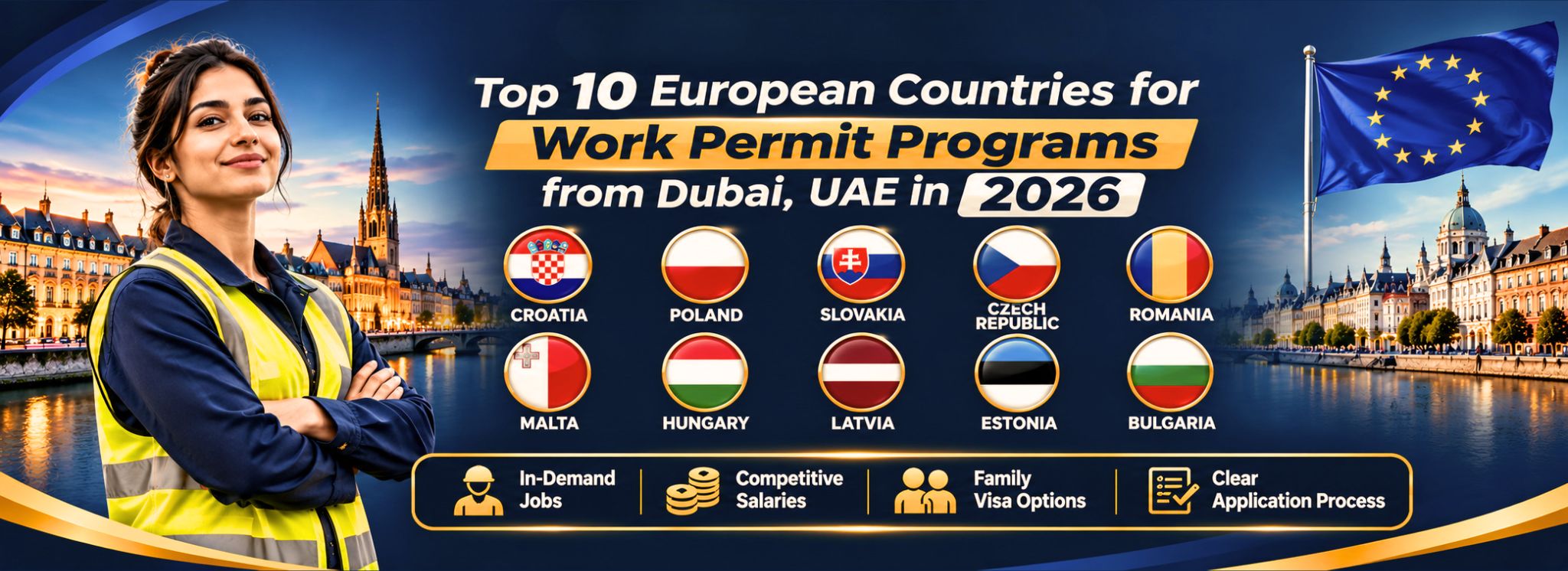
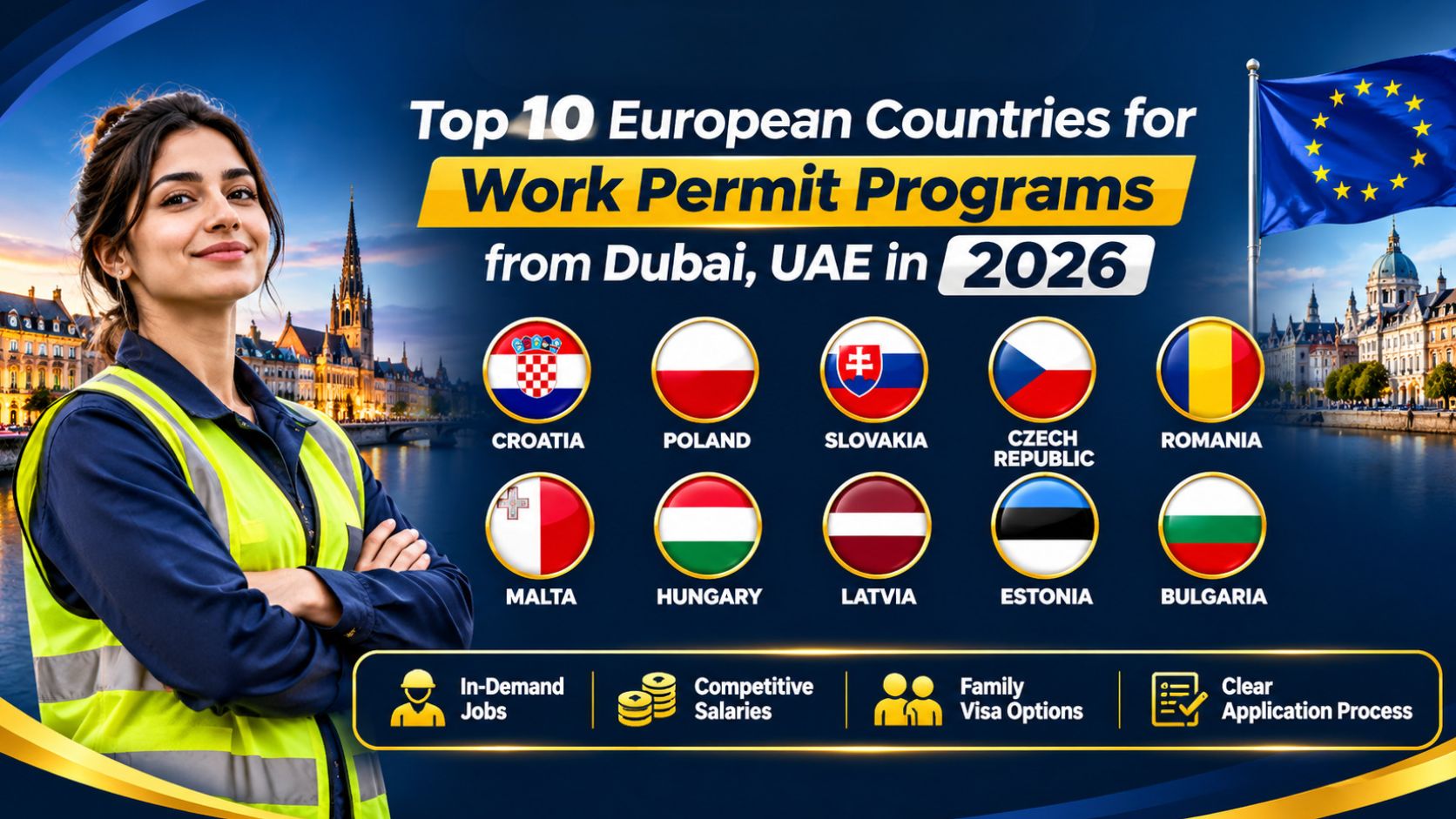
Germany, Ireland, the Netherlands, Austria, Poland, Czechia, Slovakia, Croatia, Romania and Malta are useful destinations to compare in 2026.
Germany, Ireland, the Netherlands and Austria offer routes particularly relevant to qualified professionals and skilled trades. Poland, Czechia, Slovakia, Croatia and Romania have employer-supported routes worth researching for suitable industrial, construction, transport and service occupations. Malta adds opportunities across professional services, logistics, hospitality and other sectors, subject to its permit conditions.
This is an editorial shortlist, not an official ranking. A shortage occupation or advertised vacancy does not automatically mean an employer can recruit every overseas applicant.
Europe work permit from Dubai: country and occupation comparison
The occupations below combine official shortage information with sectors worth investigating. The reports refer to different periods, including 2024–2025 labour-market evidence published or available in 2026. Check the current vacancy and permit requirements for your exact job.
| Country | Reported shortage areas or roles to investigate | Main employment route to assess |
|---|
| Germany | Nursing and other eligible healthcare roles, engineering, IT and qualified technical trades | Skilled-worker residence route, EU Blue Card or another eligible employment route |
| Ireland | Eligible healthcare, software, engineering and specialist professional roles | Critical Skills Employment Permit or General Employment Permit |
| Netherlands | ICT, engineering and specialist professional employment; other sectors depend on ordinary work-permit eligibility | Highly skilled migrant route, EU Blue Card or an ordinary employment route |
| Austria | Graduate nursing, welding, agricultural machinery and other occupations on the 2026 shortage lists | Red-White-Red Card or EU Blue Card |
| Poland | Transport, construction, manufacturing, technical trades and selected logistics roles | Employer-supported work authorisation with the appropriate visa or residence status |
| Czechia / Czech Republic | Machine operation, building trades and eligible healthcare roles; selected production and logistics vacancies | Employee Card or EU Blue Card |
| Slovakia | Machine operation, building trades, drivers and mobile plant operation | Temporary residence for employment and applicable labour approval |
| Croatia | Construction trades, cooks, hospitality, mechanics and selected transport roles | Stay and work permit; seasonal employment has separate conditions |
| Romania | Building trades, plant and machine operation, selected business-support roles | Employer work authorisation, employment visa and residence permission |
| Malta | Trade, transport and storage, accommodation and food services, professional and administrative services | Single Permit or another eligible specialist employment route |
Sources: EURES country labour-market information, Austria’s 2026 shortage list, Ireland’s Critical Skills list and Malta’s Q2 2026 vacancy report.
Salary ranges and benchmarks: what could you earn?
The following figures are gross, before tax. They are selected, dated examples, rather than uniform national salary ranges. A warehouse role, a qualified trade and an experienced professional role have different pay levels. The examples also do not establish that the named employer sponsors applicants from the UAE or has an arrangement with The Global Axis.
| Country | Salary example or benchmark | Role and evidence |
|---|
| Germany | EUR 2,861–4,075 per month | Lower-to-upper quartiles for qualified warehouse logistics workers in the Federal Employment Agency’s retrieved national table. Median: EUR 3,382. Source |
| Ireland | EUR 45,514–65,068 per year | HSE staff physiotherapist scale, effective June 2026. Other occupations and seniority grades differ. Source |
| Netherlands | EUR 5,212–8,387 per month | An ING backend and data engineer example, based on a 36-hour week. This is an experienced professional salary scale. Source |
| Austria | EUR 2,660–3,330 per month | AMS welder entry-pay benchmark based on qualification and collective-agreement minimums, stated as 2025 data. Confirm the applicable 2026 agreement. Source |
| Poland | PLN 5,500–6,000 per month | A Lechpol full-time warehouse job advertisement; bonuses are additional and subject to its conditions. Source |
| Czechia | CZK 38,150–42,233 per month | A Lidl warehouse/loading role for 35 hours weekly: advertised starting pay through the step reached after two years. Source |
| Slovakia | EUR 1,035–1,400 per month | Selected basic gross welder pay amounts in 2026 postings on the Slovak public employment portal. These span different offers, not one employer’s pay ladder. Example 1 · Example 2 |
| Croatia | Approximately EUR 1,630–1,990 per month | Selected cook/head-cook base-pay examples in October–November 2026 public employment-service listings. Role, seniority and benefits differ. HZZ job portal, listing IDs 167119011 and 168030301. |
| Romania | RON 5,400–6,500 per month | A welder vacancy from SIMCOR VAR listed through ANOFM; gross pay as stated in the official vacancy. Source |
| Malta | EUR 1,412–3,657 per month | The span between average basic salaries for elementary occupations and managers in the national Q2 2026 survey. These are occupational-group averages, not a single job’s range. Source |
Before comparing an offer with your Dubai income, calculate take-home pay after tax, social contributions, accommodation, transport, food, insurance and family costs. Confirm paid hours, overtime, shift allowances and any deductions in writing. In Austria, also check the contract’s additional salary payments and collective agreement.
1. Germany: qualified employment and settlement options
Germany is worth assessing if you have a recognised qualification, a suitable professional background and a qualifying job offer. Healthcare, engineering, IT and technical trades are important areas to investigate.
The work visa for qualified professionals generally requires a recognised or comparable qualification and a qualified position. Auxiliary tasks alone are insufficient for this route. Regulated healthcare roles also require professional authorisation. Other employment routes, including the EU Blue Card and certain experienced-worker routes, have their own requirements.
Family: Eligible spouses and children can apply for family reunification. An approved spouse’s residence permission can allow employment, subject to the applicable rules.
PR opportunities: Qualifying skilled workers may apply for a settlement permit after three years, with conditions including 36 months of pension contributions, financial self-support, German-language knowledge and other requirements. The exact qualifying period depends on the residence route.
2. Ireland: English-speaking employment and Critical Skills routes
Ireland can suit qualified healthcare workers, software professionals, engineers and other applicants whose roles meet the relevant occupation and permit rules.
The Critical Skills Employment Permit and General Employment Permit require eligible employment. In 2026, the general GEP annual remuneration threshold is EUR 36,605, while a principal CSEP threshold is EUR 40,904 for eligible listed occupations and qualifications. Exceptions, public-sector provisions and other thresholds apply.
Family: Critical Skills holders can seek immediate family reunification. General Employment Permit holders face a qualifying waiting period under the family policy. Eligible family members’ employment rights depend on their approved permission.
Settlement: Eligible CSEP workers may seek a Stamp 4 upgrade after 21 months; qualifying GEP workers may do so after 57 months. Stamp 4 is renewable immigration permission. Long-term residence is a separate application, commonly assessed after five years of qualifying residence.
Explore Ireland skilled migration from Dubai.
3. Netherlands: recognised sponsors and professional roles
The Netherlands is particularly relevant to experienced ICT, engineering and specialist professional applicants.
The highly skilled migrant route requires an eligible recognised sponsor and the applicable salary conditions. For a first application in 2026, the standard gross monthly amounts are EUR 5,942 for applicants aged 30 or older and EUR 4,357 for those under 30, excluding holiday allowance. A separate reduced criterion applies to eligible applicants. Always check the current IND amounts.
An ordinary employment route, such as a combined residence and work permit, has different employer requirements. A lower-paid warehouse or service role should not be assumed eligible for the highly skilled migrant route.
Family: Eligible partners and children can apply to join. A highly skilled migrant’s partner is generally free to work; partners of ordinary GVVA holders generally need an employer with a separate work permit.
PR opportunities: Permanent residence may be available after five qualifying years, subject to residence, income, integration and other conditions.
4. Austria: skilled workers in 2026 shortage occupations
Austria’s 2026 nationwide shortage list includes graduate nursing, welding and agricultural machinery occupations, alongside other eligible professions. A separate regional list applies to specified provinces.
The Red-White-Red Card for shortage occupations requires relevant training, a suitable job offer, the necessary points and appropriate pay. Check recognition and language requirements for your occupation.
Family: Eligible family members can obtain a Red-White-Red Card plus when its conditions are met. This title allows unrestricted access to the Austrian labour market.
PR opportunities: After five qualifying years of settlement, eligible applicants may seek Long-term Resident–EU status, including the required integration conditions and normally B1 German. A Red-White-Red Card plus can provide broader employment access earlier, but it remains a fixed-term residence title.
5. Poland: manufacturing, transport and logistics routes
Poland is worth researching for construction trades, manufacturing, transport and selected warehouse and logistics roles. Check the specific duties, qualifications, driving requirements and employer’s eligibility to recruit you.
Ordinary overseas employment generally involves employer-supported work authorisation and the appropriate entry visa or residence basis. A work-authorisation document and the right to enter or reside in Poland serve different purposes. Current residence-and-work salary rules include a minimum of PLN 4,806 gross monthly, alongside comparable-pay requirements.
Family: The standard family reunification route generally requires the sponsor to have completed two years on qualifying consecutive temporary residence permits, with further permit conditions. Other bases and exceptions can apply. Early family entry and a partner’s employment rights need individual checking.
PR opportunities: For an ordinary worker, the usual settlement route to assess is EU long-term resident status after five qualifying years, with income, insurance and Polish-language conditions. Polish permanent residence is a separate status with specific eligibility categories.
6. Czechia: Employee Cards and industrial careers
Czechia, also known as the Czech Republic, has reported shortages in machine operation, building trades and healthcare. Selected logistics and production vacancies are also worth investigating, although sponsorship and language requirements vary.
The Employee Card is a principal route for eligible non-EU workers. The job, contract, wages, hours and vacancy-registration requirements must be met. Embassy application capacity and appointment rules should be checked before setting a start date.
Family: Under the qualifying family reunification route, an Employee Card holder normally needs at least six months of residence before the relevant spouse or child application. Additional conditions apply. A person granted this family reunification residence permit has free access to the labour market; other family visa types can have different rights.
PR opportunities: Permanent residence is commonly available after five years of qualifying continuous residence, with the applicable language and other conditions.
7. Slovakia: manufacturing and technical employment
Slovakia is a destination to investigate for machine operation, qualified building trades, welding and transport-related roles. An employer’s actual vacancy and your occupational skills should guide the application.
The principal route is temporary residence for employment, normally supported by the applicable Labour Office approval or work-permit process. The role is linked to a concrete employer, position and place of work. Changing these may require further approval.
Family: Eligible spouses and children may seek family reunification. Check the partner’s employment-authorisation conditions and timing rather than assuming immediate unrestricted work rights.
PR opportunities: Long-term residence can be available after five qualifying years, subject to continuity and the applicable statutory requirements. Seasonal residence does not count towards that standard five-year period. Plan for the current language and supporting-document requirements.
8. Croatia: construction, hospitality and transport
Croatia’s labour-market information identifies shortages across selected construction trades, hospitality, mechanics and transport occupations. Job requirements and opportunities differ between coastal tourism regions and other parts of the country.
An employer-supported stay and work permit is the main route to assess. Labour-market testing and Croatian Employment Service opinions depend on the case. Eligible permits can be issued for up to three years under the current framework, with different limits for some categories.
Family: Reunification may be available, but waiting periods and eligibility depend on the sponsor’s permit category. Seasonal-worker permissions have important family restrictions.
PR opportunities: Long-term residence can be available after five qualifying continuous years, with additional conditions. Seasonal-work periods are excluded from the standard calculation. Choose the route with your longer-term plans in mind.
9. Romania: employer authorisation and residence planning
Romania has reported shortages in building trades, stationary plant and machine operation, alongside selected business-support occupations. Match the actual job to your training and the employer’s recruitment requirements.
The usual sequence is an employer work authorisation, the appropriate employment visa and residence formalities. Romania’s “permanent worker” label describes an employment category; long-term residence has its own qualifying test.
Family: Eligible sponsors holding the required residence status can request approval for family reunification. The ordinary sponsor conditions include an appropriate permit valid for at least one year, together with the relevant financial, housing and other requirements.
PR opportunities: Long-term residence commonly requires five years of qualifying continuous stay, sufficient resources, health coverage, accommodation and Romanian-language knowledge.
2026 pay check: The national basic gross minimum increased to RON 4,325 monthly from 1 July 2026. Confirm the current statutory and role-specific requirements against the contract offered.
10. Malta: a Single Permit with 2026 entry requirements
Malta’s Q2 2026 vacancy data highlights opportunities across trade, transport and storage, accommodation and food services, professional activities and administrative support. A sector’s vacancy rate does not establish that every role qualifies for a work permit.
The Single Permit combines residence and employment authorisation and is linked to the specified employment. First-time applicants must check the 2026 Pre-Departure Course requirement, with verification introduced from 1 March 2026 for applicable applications. Additional sector requirements can apply.
Family: The statutory family reunification route includes a two-year sponsor-residence requirement and financial, housing and insurance conditions. A separate Family Members Policy has its own criteria. Family residence permission and a partner’s right to work require separate checks.
PR opportunities: Eligible applicants can seek long-term residence after five qualifying years, with resources, accommodation and integration requirements. An initial Single Permit does not itself grant long-term status.
What can your family benefit from?
Approved family relocation may allow your household to live together, children to attend school and a partner to take employment where their permission allows it. Healthcare access, insurance obligations, school arrangements and any benefits depend on national rules and the residence status granted.
For a Europe work permit from Dubai, review these questions before choosing a destination:
- Can the family apply together, or is there a waiting period?
- Does the partner’s permission allow work, or is another approval needed?
- Is the proposed income sufficient for family sponsorship and living costs?
- Which housing, health-insurance and relationship documents are required?
- How do the children’s ages and dependency affect eligibility?
Accommodation, transport and insurance should be treated as contractual benefits only when the offer confirms them. Check whether they cover the employee alone or accompanying dependants.
How to apply for a Europe work permit from Dubai through The Global Axis
Step 1: Assess your profile and destination options
Prepare your CV, nationality, country of birth, age, UAE residence details, qualifications, occupational experience, language skills and family information. The relevant rules depend on your personal profile as well as the destination.
Step 2: Confirm a suitable route and genuine employment
For most routes in this guide, an eligible job offer is central. Confirm the employer, duties, location, salary, hours and required qualifications. Ask which destinations and support services are currently available through The Global Axis and its professional partners.
Step 3: Prepare the documents in the correct format
Common documents include a valid passport, UAE residence evidence, CV, qualifications, employment references, police clearances, relationship certificates and the employment contract. Translation, legalisation, professional registration and medical requirements vary by country and occupation.
Step 4: Complete employer and professional approvals
The employer may need work authorisation, sponsorship, vacancy registration or labour approval. Regulated professions may also require destination-country recognition and registration. Follow the correct sequence for your chosen route.
Step 5: Apply through the competent visa or residence channel
Check whether the relevant mission accepts your application based on your UAE residence, what appointments are available and which authority makes the decision. A document-submission appointment does not itself approve the visa.
Step 6: Arrange travel and post-arrival formalities
Confirm entry permission, the authorised employment start date, address registration, biometrics, residence-card collection and insurance requirements before travelling. Keep your residence and work conditions valid throughout employment.
Step 7: Keep a clear written service plan
Request an itemised scope covering the services, professional partners where relevant, fees, third-party costs, responsibilities and refund terms. Separate employer recruitment, professional licensing and immigration decisions when discussing milestones.
Explore The Global Axis Europe work permit services or compare the company’s skilled migration programs.
FAQs: Europe work permit from Dubai in 2026
Which European country is easiest for a work permit from Dubai?
There is no single easiest destination for every UAE resident. A qualifying job, the employer’s eligibility, your nationality, skills, salary and application requirements determine which route is realistic. Compare suitable offers and legal routes rather than relying on a universal “easy visa” claim.
Can I apply from Dubai if I am not a UAE citizen?
You may be able to apply through the competent mission or application channel as a legal UAE resident. Check the destination’s consular jurisdiction, residence-history and nationality requirements. A UAE residence visa does not replace a European work or entry permission.
Do I need a job offer for a Europe work permit?
Most employment routes covered here require a suitable offer and employer involvement. Some countries have separate job-search routes, but those permissions have their own conditions and do not automatically authorise unrestricted employment.
Can warehouse workers, drivers and tradespeople apply?
Potentially, where the specific job and applicant qualify for an available route. Check vocational evidence, licences, professional driving qualifications, language requirements and salary. A general helper role should not be assumed eligible for a qualified-worker or highly skilled migrant route.
Is IELTS required for a European work permit?
There is no single Europe-wide IELTS rule. Language requirements depend on the country, occupation, employer, regulator and permit. Local-language ability can be essential. Malta’s applicable first-time Single Permit process includes its pre-departure requirements, including English-language preparation and assessment elements.
Can my spouse and children join me?
Many routes allow eligible family applications, subject to the sponsor’s status, residence history, income, housing, insurance and relationship evidence. A partner’s right to work must be checked separately. Family eligibility should be assessed before committing to a move.
Does a work permit lead to PR after five years?
Several destinations offer long-term or permanent-residence routes after five qualifying years. Approval also depends on conditions such as continuity, income, insurance, language and integration. Some residence types do not count. Germany has separate qualifying skilled-worker settlement options, while Ireland’s Stamp 4 follows its own rules.
Can I use a Croatian or Polish permit to work in Germany?
A permit issued by one country generally authorises the employment covered by that country’s rules. It does not provide unrestricted access to another country’s labour market. Short visits in the Schengen area and permission to work are different matters; assess the destination’s work route before changing countries.
How much does a Europe work permit from Dubai cost, and how long does it take?
Costs and timing depend on the country, employer approval, visa category, documents, professional recognition and appointment availability. Request an itemised quote and a route-specific timetable. A statutory target for one stage is not a guaranteed end-to-end processing time.
How can The Global Axis help me start?
Request a profile assessment, share your CV and supporting documents, and ask for the available support for your shortlisted destination. A written plan can clarify the route, documentation, responsibilities and next steps. The relevant employer, regulator and immigration authority assess their respective approvals.
Plan your European career with The Global Axis
The right Europe work permit from Dubai should fit your occupation, finances and family plans. Start with a credible job match, understand the permit conditions and plan how you will maintain lawful residence over time.
Speak with The Global Axis immigration consultants in Dubai about the support available for your profile.
Request your free work permit eligibility assessment.
The Global Axis is a private immigration consultancy. This guide provides general information; the relevant authorities decide applications. Confirm the rules in force when you apply.