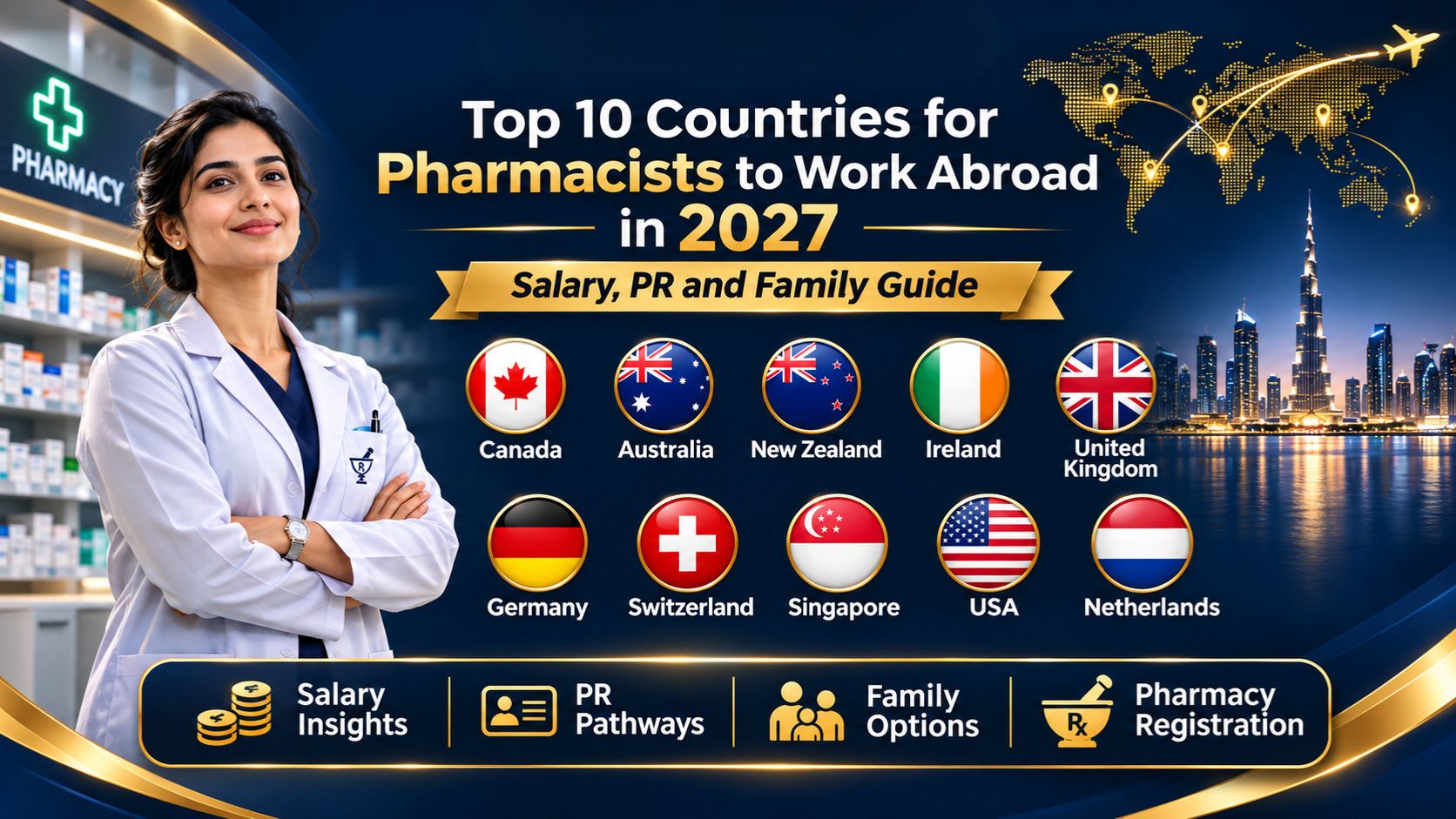
The best countries for pharmacists to work abroad in 2027 depend on more than salary. Your pharmacy qualification, registration history, language skills and family plans will determine which destinations offer a realistic route.
For pharmacists living in Dubai, Sharjah, Abu Dhabi and the wider UAE, Australia, Canada, Ireland, New Zealand, the United Kingdom, Germany, the United States, the Netherlands, Sweden and Norway are worth comparing. Each has established pharmacy careers and immigration routes, but the requirements differ substantially.
Quick answer: Australia and Canada are useful starting points for skilled migration planning. Ireland offers an English-speaking European option. New Zealand has a pharmacist residence pathway, although its current internship timetable affects new overseas applicants. The USA offers high published earnings, while Germany and the other European destinations require careful local-language preparation.
This is an editorial shortlist based on career options, licensing access, published pay and residence pathways. It is not an official ranking of visa difficulty. The 2027 outlook uses confirmed announcements and current published rules; the salary references below are not predictions of 2027 pay.
Pharmacist Salaries Abroad: Ten-Country Comparison
All amounts are gross, in local currency. The table identifies the type of evidence because a national wage range, a public pay scale and a survey average do not represent the same thing.
| Country | Published salary or pay benchmark | Basis and scope |
|---|
| Australia | AUD 1,668.95–2,470.33 a week | NSW public health Grade 1–2 pharmacist scale from July 2026; about AUD 86,785–128,457 over 52 weeks. Official award |
| Canada | CAD 40–67 an hour; median CAD 55.49 | Job Bank national low-to-high wage reference; updated November 2025, using 2023–2024 data. Government wage report |
| Ireland | EUR 50,485–80,758 a year | HSE pharmacist Grade 3247 scale from June 2026, including the long-service point. HSE scales |
| New Zealand | NZD 81,000–122,000 a year | Health New Zealand’s core pharmacist range; designated senior roles have a separate higher scale. Employer pay information |
| United Kingdom | GBP 40,000–65,000 a year | National Careers Service starter-to-experienced guidance. Government career profile |
| Germany | EUR 4,166–4,922 a month | January 2026 ADEXA/ADA pharmacist tariff, depending on professional service; agreement coverage matters. Published tariff |
| United States | USD 99,290–174,230 a year; median USD 140,910 | May 2025 BLS 10th-to-90th percentile boundaries; some earnings fall outside these points. BLS pharmacist data |
| Netherlands | EUR 4,795.36–8,201.69 a month | September 2026 responsible-pharmacist scale for 38 hours a week; not a trainee or second-pharmacist scale. Collective-agreement salary table |
| Sweden | SEK 45,100 community pharmacy; SEK 50,100 regional/municipal employers; SEK 77,400 pharmaceutical companies, a month | Separate 2025 sector averages for apotekare, not an individual salary range. Pharmacist union survey |
| Norway | NOK 644,959 bachelor-level pharmacy roles; NOK 730,831 master-level roles; NOK 963,069 pharmacy managers, a year | Separate 2025 role averages, not minimum and maximum salaries. Pharmacist union survey |
Internship and supervised-practice earnings can be lower. Before comparing an overseas offer with your UAE package, calculate take-home income after tax, housing, transport, insurance and childcare.
Which Pharmacy Roles Should You Research?
Relevant career areas include community pharmacy, hospital pharmacy, clinical pharmacy, medicines safety and pharmaceutical manufacturing. Regional healthcare employers can also be worth investigating.
Some pharmacists explore regulatory affairs, quality assurance, pharmacovigilance or clinical research. These roles may have different qualification and registration requirements from dispensing practice. Specialist experience is often necessary, and the actual duties must match the immigration occupation used.
The roles below are career areas to research. Inclusion in a skilled occupation list is an immigration eligibility signal, not proof that every employer is recruiting or sponsoring overseas applicants.
1. Australia: Community, Hospital and Regional Pharmacy
Career areas: Retail/community pharmacist, hospital pharmacist and regional pharmacy practice.
Many overseas graduates follow the Australian Pharmacy Council’s Knowledge Stream, including an eligibility assessment and OPRA. Pharmacy Board/Ahpra registration, supervised practice, training and further examinations are separate requirements. Industrial pharmacist migration assessments use a different assessing authority. Check APC assessment routes.
PR opportunities: The current occupation mapping includes subclass 190, state-nominated 491 and eligible employer-sponsored 482/186 options for pharmacist codes. Subclass 190 is permanent; 491 is provisional and requires a later qualifying permanent residence application. Check the official occupation and visa mapping.
Family: Eligible partners and children may be included under the relevant visa rules. Work, study and healthcare rights depend on the visa granted.
Explore Australia skilled migration from Dubai with The Global Axis.
2. Canada: PR Routes and a Confirmed 2027 Certification Change
Career areas: Community, hospital and clinical pharmacy; opportunities vary by province and region.
2027 update: PEBC has announced that international pharmacy graduates will no longer need its Pharmacist Evaluating Examination from January 2027. Document Evaluation and the applicable Qualifying Examination requirements remain. Provincial regulators still determine final licensing, including any language, practical training and jurisprudence requirements. Read PEBC’s announcement.
PR opportunities: Express Entry and eligible Provincial Nominee Program streams may be relevant. Pharmacists, NOC 31120, appear in the current healthcare and social services category. Applicants must also qualify for an underlying Express Entry programme and receive an invitation; check 2027 category priorities when announced. IRCC category guidance.
Family: Eligible partners and dependent children may accompany a PR applicant. A temporary worker’s spouse needs a separate assessment of open work permit eligibility.
Explore Canada skilled migration and Express Entry support.
3. Ireland: An English-Speaking European Option
Career areas: Community pharmacist, hospital pharmacist and relevant pharmaceutical industry positions.
Non-EU/EEA qualifications generally require the Pharmaceutical Society of Ireland’s Third Country Qualification Recognition, or TCQR, process before registration. Whether an examination is required depends on the assessment. PSI qualification recognition.
Residence opportunities: Pharmacist/industrial pharmacist appears on the Critical Skills Occupations List. A qualifying employment offer and the applicable permit conditions remain necessary. Eligible Critical Skills workers can seek Stamp 4 after 21 months of qualifying employment. Stamp 4 is renewable residence permission. A separate Long Term Residency scheme may be available after 60 months of qualifying employment-permit-based residence. Stamp 4 upgrades and Long Term Residency.
Family: Eligible families can seek reunification. Spouses or de facto partners granted the relevant Stamp 1G permission can take employment without their own employment permit, with restrictions including on self-employment.
Explore Ireland skilled migration from the UAE.
4. New Zealand: A Pharmacist Residence Route with Intake Restrictions
Career areas: Hospital, community and regional pharmacy.
Registration depends on your qualification and registration history. For the Non-Comparable pathway, requirements include preliminary approval, OPRA, New Zealand pharmacy legislation study, intern training and the Council’s assessment.
Timing matters: The Pharmacy Council’s current notice directs affected applicants awaiting preliminary review, and those applying from 2 July 2026 onwards, to plan for the 2028 intern programme. New applicants should factor this into a 2027 migration plan. Check the registration and intake notice.
PR opportunities: A qualifying registered pharmacist role on Green List Tier 1 may support Straight to Residence, with an accredited employer offer and the remaining conditions, including age eligibility. A Permanent Resident Visa is a later application, generally after two years as a resident and meeting the applicable requirements. Official residence route.
Family: Eligible partners and dependent children aged 24 or younger may be included in a Straight to Residence application.
Explore New Zealand skilled migration options.
5. United Kingdom: Hospital and Community Pharmacy Careers
Career areas: Hospital pharmacist, community pharmacist and clinical pharmacy positions.
For many overseas qualifications, the Great Britain registration route includes a one-year OSPAP, 52 weeks of foundation training and the registration assessment, alongside other eligibility requirements. Northern Ireland has a separate regulator. GPhC registration criteria.
Work and settlement: An eligible sponsored pharmacist job can qualify for the Health and Care Worker route when the employer, occupation, pay and other conditions are met. The government’s November 2026 settlement response describes a 10-year default framework with shorter qualifying routes, including eligible public service occupations. Pharmacists are listed in the relevant annex, but public service conditions and implementing rules matter. Read the settlement response.
Family: Eligible partners and children can apply as worker dependants. The OSPAP student stage has different family rules. Worker dependant guidance.
Explore UK skilled migration guidance.
6. Germany: Pharmacy Careers for German-Language Learners
Career areas: Community pharmacy, hospital pharmacy and relevant pharmaceutical industry roles.
Patient-facing pharmacist practice requires Approbation, the professional authorisation. Recognition assesses your qualification against German requirements. The official guidance generally calls for B2 German and a professional language examination usually at C1, with the competent state authority determining the route. Government recognition guidance.
PR opportunities: Eligible skilled workers can seek a settlement permit after three years on qualifying residence titles, subject to conditions including livelihood, pension contributions and language ability. Settlement requirements.
Family: Eligible spouses and children can apply for family reunification. Spouses joining qualifying skilled workers can generally work once the appropriate permission is granted. Family guidance.
Germany is worth shortlisting if you can invest in the required German and qualification recognition.
7. United States: High Published Earnings and Detailed Licensing Rules
Career areas: Hospital, ambulatory care and specialist clinical pharmacy. BLS expects demand growth in some healthcare settings while describing more limited growth in traditional retail pharmacy.
Foreign graduates generally need FPGEC certification, followed by the relevant state licensing requirements. For applicants graduating on or after 1 January 2003, NABP requires at least a five-year pharmacy programme at graduation. A four-year B.Pharm should not be assumed to meet this condition. NABP foreign graduate requirements.
PR opportunities: Employment-based categories such as EB-2 or EB-3, where appropriate, require a separate assessment of the job, qualifications, sponsorship and visa availability. Waiting periods can be substantial. US employment-based immigration guidance.
Family: Eligible spouses and unmarried children under 21 may qualify as derivative immigrants. On a temporary H-1B/H-4 route, spouse employment authorisation is conditional.
Check your original degree eligibility before making a USA licensing budget.
8. Netherlands: Dutch-Language Pharmacy and Industry Options
Career areas: Community pharmacy, hospital pharmacy and pharmaceutical industry roles suited to your experience.
Non-European qualifications generally require the applicable certificate of competence process and BIG registration for pharmacist practice. The published Dutch-language standard for pharmacists is B2+. Additional education or assessment may be required. Recognition procedure and language standards.
PR opportunities: An employer-supported highly skilled migrant permit may be relevant if its conditions are met. Permanent residence generally requires five consecutive years of qualifying residence, together with other conditions such as income and integration. IND permanent residence guidance.
Family: Eligible families can apply to join. Partners of highly skilled migrants are generally free to work under the relevant partner-permit conditions. IND partner guidance.
English-language industry vacancies should be assessed separately from Dutch-speaking pharmacy practice.
9. Sweden: A Longer Preparation Route
Career areas: Community pharmacy, hospital services and pharmaceutical industry.
Socialstyrelsen assesses overseas qualifications. Its non-EU/EEA pharmacist route includes education assessment, a proficiency test, Swedish laws and regulations, practical training and the licence application. Swedish is needed for the later stages. The regulator says this route usually takes two to four years, depending on the applicant’s circumstances. Official licensing route.
PR opportunities: Under the current employee route, permanent residence may be available after meeting qualifying work-permit conditions and working in Sweden for four of the past seven years, with the remaining requirements. Work and permanent residence conditions.
Family: Eligible partners and children can apply to accompany or join a worker, subject to maintenance and other requirements.
Your assessed professional category matters: the apotekare and receptarie qualifications have different roles and salary references.
10. Norway: Recognition and Norwegian Before Practice
Career areas: Community pharmacy, hospital pharmacy and appropriate medicines-related industry roles.
The Norwegian Directorate of Health assesses qualifications and authorisation. Non-EU/EEA graduates face additional requirements, including the relevant B2 language standard and applicable courses. Additional professional requirements.
Timing: The regulator currently lists 23 months for applications based on education outside the EU/EEA. Personal language preparation and additional requirements can add time. Check processing estimates.
PR opportunities: A qualifying skilled-worker permit with a Norwegian employer can provide a basis for permanent residence after three years, subject to continuous qualifying residence and the remaining conditions. UDI skilled-worker guidance.
Family: Eligible family members can usually apply to live with a qualifying skilled worker. Check relationship, maintenance and permit conditions before planning the move.
How to Choose the Best Countries for Pharmacists
Shortlist two or three destinations using these questions:
- Can your qualification be recognised? Check course duration, training and registration history first.
- Which language must you prove? A visa language requirement and a professional language requirement can differ.
- How long until you can earn as a registered pharmacist? Include exams, course intakes, placements and regulator decisions.
- What is your family budget? Check your partner’s work permission, children’s schooling and health insurance.
- Which residence route fits your profile? Distinguish permanent residence from provisional visas and renewable permissions.
A higher salary is useful only if the full move works financially. Include examination fees, regulator charges, training, travel, temporary accommodation and the period before full professional registration.
How to Apply Through The Global Axis in Dubai
An organised assessment can make overseas migration easier to understand and manage. Start with The Global Axis skilled migration programmes and discuss which available services fit your pharmacy background.
Step 1: Share your profile. Provide your pharmacy qualification, graduation year, course duration, CV, registration history and family plans.
Step 2: Compare suitable destinations. Review licensing access, migration eligibility, expected costs and realistic timing before choosing a route.
Step 3: Agree the service scope. Confirm the services, fees, third-party costs and who will provide regulated immigration advice where required. Professional registration decisions remain with the overseas pharmacy regulator.
Step 4: Prepare applications in the correct order. Depending on the country, this can involve recognition, language evidence, examinations, nomination or an eligible employer offer, followed by the relevant visa application.
Step 5: Include the family plan. Check each person’s documents, work or study rights, insurance and relocation arrangements.
Commonly needed records include passports, UAE residence details, degree transcripts, internship evidence, DHA/DOH/MOHAP records where applicable, good-standing certificates and detailed employment references. Some authorities require documents directly from the issuing institution.
Ready to plan your next pharmacy career move? Book a free consultation with The Global Axis to discuss your profile and available migration services.
Call: +971 4 546 8555 · Mobile: +971 50 306 4316 · Email: info@theglobalaxis.com
Dubai office: M11, Mezzanine Floor, Bank Street Building, Khalid Bin Al Waleed Road, Al Mankhool, Dubai, UAE.
Frequently Asked Questions
Which are the best countries for pharmacists to work abroad in 2027?
Australia, Canada, Ireland, New Zealand, the UK, Germany, the USA, the Netherlands, Sweden and Norway are worth comparing. Your best choice depends on degree recognition, language, licensing costs, family needs and migration eligibility.
Can I work overseas with a DHA, DOH or MOHAP licence?
A UAE licence does not automatically authorise overseas practice. You must satisfy the destination regulator and hold the correct immigration permission. Your UAE experience and registration can support your evidence.
Which country has the highest pharmacist salary?
The USA has a high published median of USD 140,910 in May 2025. However, a fair comparison must account for tax, living costs, working hours and professional eligibility; the ten-country table uses different pay measures.
What changes for pharmacists moving to Canada in 2027?
PEBC has announced removal of its Pharmacist Evaluating Examination from January 2027. Document Evaluation, applicable Qualifying Examination requirements and provincial licensing remain. The change does not grant immigration approval.
Can pharmacists get PR without an overseas job offer?
Some Australian state-nominated and Canadian immigration routes may be assessed without a job offer, depending on the exact stream and current criteria. Other routes require eligible employment. Professional registration remains a separate requirement for practice.
Can my spouse and children join me?
Many skilled work and residence routes allow eligible family members. Spouse work rights, dependant age limits, school access and healthcare coverage depend on the specific permission and local rules. Assess each family member separately.
Is a four-year B.Pharm accepted in every country?
No. Regulators assess qualifications differently. NABP’s FPGEC requirements generally call for a five-year pharmacy programme at graduation for applicants graduating on or after 1 January 2003. Obtain the regulator’s assessment before assuming USA eligibility.
Is New Zealand a quick option for a new overseas pharmacist in 2027?
Do not assume so. The Pharmacy Council’s current notice directs affected Non-Comparable pathway applicants to plan for the 2028 intern programme. Applicants on other recognition routes should check their individual requirements.
Do pharmacists always need IELTS?
Requirements differ. English-speaking regulators publish accepted tests, other evidence and exemptions. Germany, the Netherlands, Sweden and Norway require the appropriate local language for regulated pharmacy practice.
How can The Global Axis help me apply from Dubai?
Start with a profile consultation to compare the company’s available migration services, documentation needs, costs and next steps. Confirm the agreed scope in writing. Job offers, licences and visas remain subject to the responsible organisations’ decisions.
Information note: This is general information for 2027 planning, based on sources checked on 14 November 2026. Rules, occupation lists, pay scales and intake dates can change. Check current requirements before applying.