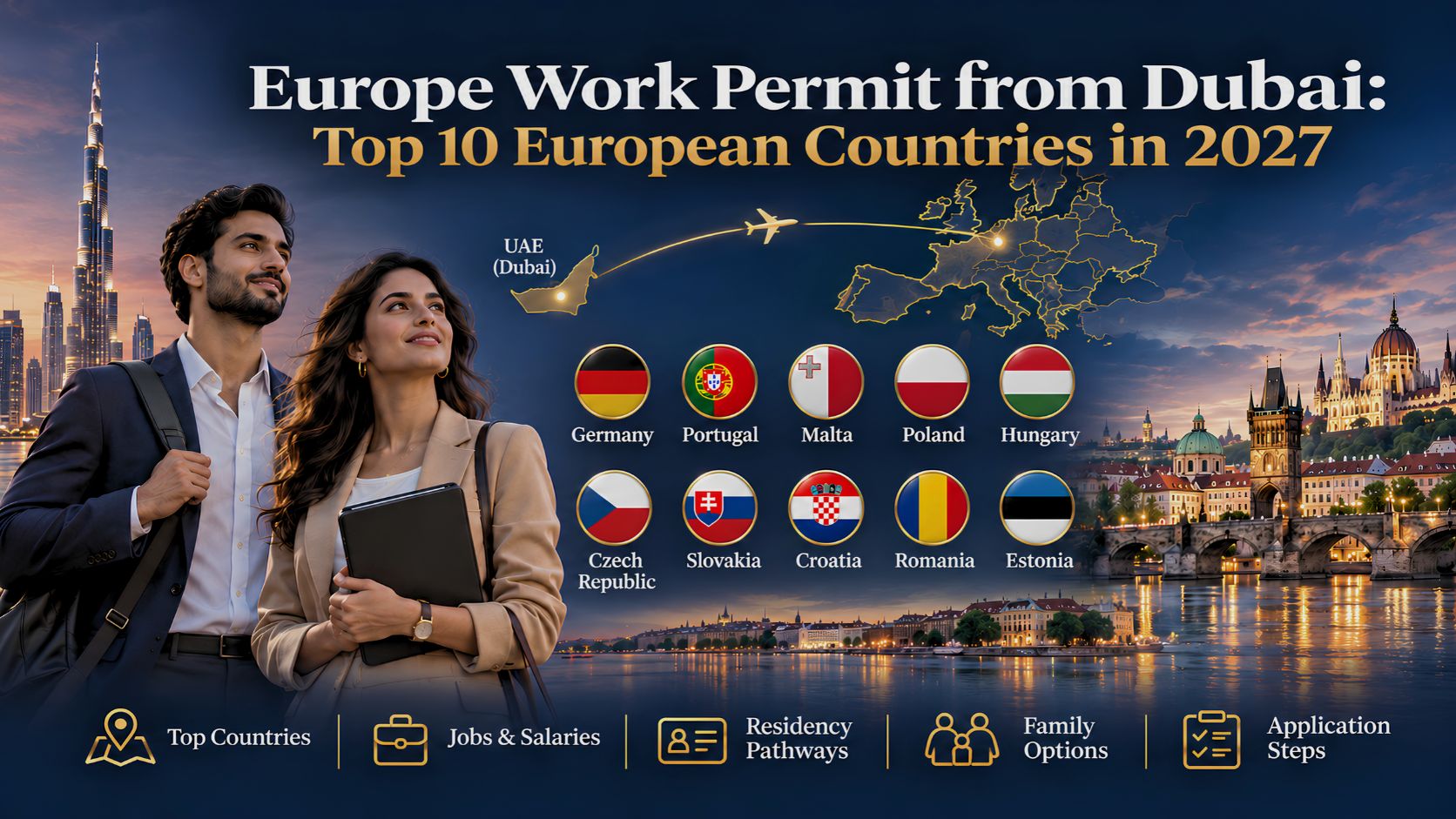
To plan a Europe work permit from Dubai, match your occupation and qualifications to a genuine job offer. Germany, Ireland, the Netherlands, Austria, Poland, Czechia, Slovakia, Croatia, Latvia and Malta offer different routes for eligible UAE residents planning to work in Europe in 2027.
Which countries should you consider first? Germany, Ireland and the Netherlands merit investigation for qualified professional roles. Austria can suit eligible technical workers. Poland, Czechia, Slovakia, Croatia and Latvia have opportunities in selected trades and industrial occupations. Malta offers opportunities in personal services and selected business roles. The right choice depends on the employer, permit category, family plans and money remaining after living costs.
This guide compares in demand professions, salary benchmarks, family options, pathways towards permanent or long term residence, and application steps with The Global Axis Immigration Services LLC in Dubai.
Research checked: 26 November 2026. This is a 2027 planning guide using published rules and available salary evidence. Confirmed future measures are identified separately. The shortlist is an editorial comparison, rather than an official ranking of approval rates or visa speed.
Compare ten European work permit destinations
The routes below concern non EU nationals. EU citizenship, nationality specific arrangements, seasonal employment and specialist permissions can change the requirements.
| Country | Professions and sectors to investigate | Main employment route to assess |
|---|
| Germany | Healthcare, engineering, ICT and qualified trades | Qualified employment residence route or EU Blue Card |
| Ireland | Healthcare, ICT and engineering | Critical Skills Employment Permit or General Employment Permit |
| Netherlands | Engineering, specialist business roles and technology | Highly skilled migrant route, EU Blue Card or another eligible employment route |
| Austria | Metalworking, technical trades, ICT and engineering | Red White Red Card or EU Blue Card |
| Poland | Welding, construction, transport and selected hospitality roles | Employer supported work authorisation plus appropriate entry and residence permission |
| Czechia | Production, machine operation, construction and technical roles | Employee Card or EU Blue Card |
| Slovakia | Industrial production, technical trades, transport and logistics | Temporary residence for employment and the applicable labour authorisation procedure |
| Croatia | Building trades, metalworking, ICT and selected hospitality roles | Stay and work permit |
| Latvia | Construction, metalworking and eligible healthcare roles | Employer supported residence permission with employment rights |
| Malta | Personal services, hospitality and selected business occupations | Single Permit or another eligible specialist route |
The profession examples draw on the national EURES labour market reports linked in the country sections. Those reports combine indicators from different years, including 2024 and 2025. A shortage observation does not establish a current vacancy, overseas recruitment or guaranteed permit eligibility.
For advice on narrowing the list, explore The Global Axis Europe work permit services.
Salary ranges for 2027 planning
The following figures are published earnings benchmarks checked in November 2026. They are not guaranteed starting salaries, immigration salary thresholds or predictions of 2027 pay.
Gross means before deductions. Net means take home pay as reported by the source. Different occupations, currencies, experience levels and pay periods prevent a direct country ranking from these figures alone.
| Country | Example occupation | Published salary range | Pay basis and source |
|---|
| Germany | Software engineer | €3,560-€8,596 | Monthly gross, middle 80% of Paylab survey salaries |
| Ireland | .NET/C# developer in Dublin, 3-5 years’ experience | €55,000-€70,000 | Annual gross, Morgan McKinley 2026 salary guide range |
| Netherlands | Software engineer | €3,743-€6,802 | Monthly gross, middle 80% of Paylab survey salaries |
| Austria | Welder | €2,660-€3,330 | Monthly gross entry pay, technical school qualification examples Austrian Public Employment Service, AMS |
| Poland | Welder | PLN 5,177-12,207 | Monthly gross, middle 80% of Pensjometr survey salaries |
| Czechia | Welder | CZK 32,012-61,674 | Monthly gross, middle 80% of Platy.cz survey salaries |
| Slovakia | Welder | €1,208-€2,812 | Monthly gross, middle 80% of Platy.sk survey salaries |
| Croatia | Welder | €1,111-€2,416 | Monthly net, middle 80% of MojaPlaća survey salaries |
| Latvia | Welder | €936-€2,120 | Monthly net, middle 80% of Algas.lv survey salaries |
| Malta | Cook | €1,122-€2,226 | Monthly gross, middle 80% of Paylab survey salaries |
The survey ranges describe existing workers with varied backgrounds. The Austrian figures describe entry pay, while the Irish example describes a particular experience band and city. Check contractual annual payments, working hours and allowances separately.
Two confirmed minimum wage changes for 2027
Do not compare these gross minimums directly with net survey figures. Other countries’ statutory wages, collective agreements and immigration salary thresholds require their own checks for the application date.
Compare savings before comparing countries
Request a written offer showing basic gross salary, guaranteed hours, overtime arrangements and estimated deductions. Then subtract accommodation, utilities, transport, food, insurance, childcare and family costs.
An employer provided room can change the budget considerably, but check its price, location, occupancy and conditions. Count meals, transport or insurance as employer benefits only when the contract confirms them.
Country requirements, family options and residence pathways
1. Germany: qualified professionals and skilled trades
Professions to investigate: Engineering, health related roles, technical occupations and qualified building trades feature in EURES Germany’s labour market information. ICT applicants should match their expertise to a genuine specialist vacancy.
Work route: Assess the qualified employment route or EU Blue Card. Qualifications, job duties, professional recognition and the applicable salary requirements matter. Germany’s Skilled Immigration Act guidance explains the main options. Regulated professions can require recognition and language preparation before employment.
Family: Eligible spouses and children can apply under the relevant family route. An approved joining spouse can work. Review the official spouse reunification conditions.
Residence opportunity: Eligible EU Blue Card holders can seek settlement after 27 months of qualifying employment with A1 German, or 21 months with B1, alongside the other conditions. Other skilled worker routes have different requirements. See Germany’s settlement permit guidance.
For UAE applicants: Include recognition, registration and language costs when comparing an offer with your Dubai employment package.
2. Ireland: healthcare, technology and engineering
Professions to investigate: Health, ICT, science and engineering professionals appear among the shortage groups in EURES Ireland.
Work route: The Critical Skills Employment Permit requires an eligible offer and the applicable occupation, qualification and remuneration conditions. The General Employment Permit covers a broader range of eligible employment. A job title alone does not establish eligibility.
Family: CSEP holders can generally seek nuclear family reunification without the ordinary one year wait. GEP holders generally become eligible to apply after one year, subject to the family and financial rules. Eligible spouses and partners granted the appropriate Stamp 1G permission can work without a separate employment permit. Check Ireland’s current family guidance.
Residence opportunity: Eligible CSEP workers can seek Stamp 4 after 21 months of qualifying employment the corresponding GEP period is 57 months. Stamp 4 is renewable permission. The separate Long Term Residency scheme assesses at least 60 months of qualifying residence. Sources: Stamp 4 upgrades and Long Term Residency.
Explore The Global Axis Ireland skilled migration guidance for a focused assessment.
3. Netherlands: specialist roles with an eligible sponsor
Professions to investigate: Engineering and selected business occupations feature in EURES Netherlands. Technology applicants should investigate vacancies requiring their particular skills.
Work route: The highly skilled migrant route normally requires an IND recognised sponsor and the applicable salary conditions. It is a specialist route a general warehouse or hospitality offer should not be assessed against its criteria. Other employment routes have different requirements.
Family: Eligible partners and children may join. A partner of a highly skilled migrant can work freely under the approved family permission rights can differ when the sponsor holds another type of permit. See the IND partner guidance.
Residence opportunity: Permanent residence can become an option after five qualifying years, subject to continuity, income, integration and other conditions. See IND permanent residence requirements.
For UAE applicants: Verify the sponsor and budget for housing before comparing the salary with other destinations.
4. Austria: technical skills and shortage occupation routes
Professions to investigate: Metal and machinery trades, ICT professionals and engineering related occupations appear in EURES Austria.
Work route: The Red White Red Card shortage occupation route considers factors including training, an eligible job offer, points and appropriate pay. Check the occupation list applicable to the intended application year. A 2026 listing does not by itself confirm a 2027 listing.
Family: Eligible family members can receive a Red White Red Card Plus with free labour market access. Income, housing, insurance and, where applicable, German language conditions must be assessed.
Residence opportunity: Eligible workers may progress to a Red White Red Card Plus after qualifying employment. This is distinct from long term resident status, which generally requires five years of lawful settlement and completion of Integration Agreement Module 2. Review the official family and residence guidance.
For UAE applicants: Match your actual training and work history to the Austrian occupation, rather than relying on an English job title.
5. Poland: manufacturing trades, transport and construction
Professions to investigate: Welding, selected building trades, transport and some food service occupations feature in EURES Poland. Drivers must also investigate licence recognition and professional qualifications.
Work route: The employer follows the applicable work authorisation procedure. Work authorisation, a visa and residence permission perform different functions. UAE residents must also follow the Polish Embassy’s national D visa procedure, including the current appointment and personal submission rules in Abu Dhabi.
Family: For the standard temporary worker family reunification route, the sponsor generally needs two years on successive temporary residence permits, with the most recent permit granted for at least one year. Exceptions apply. A qualifying family reunification residence permit provides work access without a separate work permit. See Poland family guidance.
Residence opportunity: EU long term resident status generally requires five qualifying years, stable income, insurance and accepted evidence of B1 Polish, subject to exemptions. See the official long term resident requirements.
For UAE applicants: The Embassy states that it does not cooperate with intermediaries. Private document support cannot create appointment priority.
6. Czechia: Employee Card opportunities for eligible vacancies
Professions to investigate: Technical, production and construction roles merit investigation using EURES Czechia and actual employer vacancies.
Work route: An Employee Card combines long term residence and employment permission in the relevant cases. Applicants normally need the appropriate vacancy reference, employment evidence and supporting documents. Confirm the competent mission’s jurisdiction and appointment availability before preparing a submission from the UAE.
Family: An Employee Card sponsor who has resided in Czechia for over six months can qualify to sponsor under the relevant family reunification rules. A qualifying reunification residence permit gives free labour market access a different family visa can carry different rights. See official family reunification guidance.
Residence opportunity: Permanent residence can be assessed after five qualifying continuous years, subject to applicable evidence and other requirements. See Czechia’s five year permanent residence route.
For UAE applicants: Confirm whether your nationality and UAE residence history allow submission through the intended diplomatic mission.
7. Slovakia: industrial production and technical occupations
Professions to investigate: Production, logistics and technical occupations appear in EURES Slovakia. Research the specific factory, site or transport employer offering the role.
Work route: Ordinary employment generally involves temporary residence for employment and the applicable labour office confirmation or work authorisation process. Exemptions depend on status. The EU immigration portal outlines the route use current national instructions for the submission checklist.
Family: Eligible relatives can apply for family reunification. Under the current employment legislation, ordinary family reunion residents generally need work authorisation during the initial nine month period. Permit free employment becomes available after the qualifying continuous period specified categories have exceptions. See Slovakia’s employment legislation, Section 23a.
Residence opportunity: Long term residence generally requires five qualifying years. Current legislation also requires A2 Slovak for the relevant applicants, with exemptions. See the Residence of Foreigners Act, Sections 52–54.
For UAE applicants: Confirm accommodation terms, shifts and the actual employment location before accepting an industrial offer.
8. Croatia: construction, metalworking and hospitality
Professions to investigate: Building trades, metalworking, selected ICT occupations and hospitality vacancies merit investigation through EURES Croatia. Check whether a tourism contract is seasonal or year round.
Work route: The employer supports the applicable HZZ procedure and stay and work application. Labour market test exemptions do not automatically remove other approval requirements. Review the current Croatian Ministry of the Interior guidance.
Family: For the specified ordinary HZZ opinion work permit category, current guidance requires the sponsor to have two years of continuous approved temporary residence, with the relevant permit issued or renewed for at least one year. Exceptions apply. A spouse’s employment rights depend on the residence category ordinary family residence should not be assumed to provide unrestricted work access.
2027 development: From 4 June 2027, specified workers who have resided in Croatia for at least one year become subject to an A1.1 Croatian language and Latin script examination obligation, with evidence required for specified subsequent applications. The employer pays the examination cost. Exemptions include seasonal workers. See the 2026 amendments, Articles 19 and 70.
Residence opportunity: Long term residence generally requires five qualifying continuous years plus financial, insurance and language conditions. Seasonal work should not be assumed to build the same residence pathway. See MUP long term residence guidance.
9. Latvia: construction and metalworking roles
Professions to investigate: Building trades, metal and machinery trades, and health professionals feature in EURES Latvia. Healthcare applicants need a separate professional recognition assessment.
Work route: The Latvian employer supports the relevant recruitment and invitation procedure. The worker must hold the appropriate permission with employment rights. Review Latvia’s Office of Citizenship and Migration Affairs employment guidance, including the current occupation related pay requirements.
Family: Eligible spouses and children can apply through the relevant family route. Family members of qualifying employment based residence permit holders can have unrestricted work access under their approved status. A work visa should not be treated as interchangeable with employment based residence for family planning. See Latvia family guidance.
Residence opportunity: Permanent residence may become available after five qualifying continuous years, subject to Latvian language requirements, generally at least A2, and the other conditions described by the migration authority.
For UAE applicants: Compare the offer’s take home pay with local housing costs and the employer’s proposed deductions.
10. Malta: personal services and selected business roles
Professions to investigate: Personal services and selected business and administration occupations appear among the shortage groups in EURES Malta. Hospitality applicants should check actual vacancies and role specific conditions.
Work route: The Single Permit combines the relevant residence and employment permission. Malta introduced a mandatory pre departure course for first time Single Permit applicants in 2026, subject to the published scope. Check the applicable course and Skills Pass requirements through Identità’s current guidance.
Family: Formal family reunification and the discretionary Family Members Policy have different conditions. Current guidance describes a two year sponsor residence requirement under the formal route and generally 12 months under the policy, with specified exceptions. Policy dependants need their own work authorisation to take employment. See Identità’s family guidance.
Residence opportunity: EU long term resident status generally requires five qualifying years, adequate resources, accommodation and integration conditions. See Malta’s long term residence guidance.
For UAE applicants: Add course, housing, insurance and family document costs to your relocation budget.
Can your family benefit from the move?
Family benefits are a major part of choosing a Europe work permit from Dubai. An approved family route can allow a household to live together and, in some categories, give the accompanying spouse access to employment.
| Family priority | What to investigate |
|---|
| Moving together | Whether the sponsor’s category allows an accompanying application or imposes a residence history requirement |
| Spouse’s career | The exact employment rights attached to the family permission |
| Children’s education | Admission arrangements, local language, school availability and public or private costs |
| Healthcare | Registration, insurance eligibility and any separate dependant cover |
| Long term stability | Renewal conditions, qualifying residence and the family member’s own future status |
A dependant’s visa does not automatically include free accommodation, cash benefits or immediate healthcare coverage. Confirm each entitlement and budget before moving. The country sections link to the relevant family rules.
What does “PR opportunity” mean?
Permanent residence, EU long term resident status and renewable permissions such as Ireland’s Stamp 4 are different statuses. Five years of employment does not automatically establish eligibility for any of them.
Check which residence periods count, permitted absences, language or integration requirements, income and insurance. A Croatian, Polish or other national permit also does not automatically authorise employment elsewhere in Europe. Ireland applies its own immigration system and is outside the Schengen Area.
Application steps from Dubai and the UAE
Step 1: Build a shortlist around your actual experience
Prepare your CV, qualifications, employment history, nationality and UAE residence details. Identify whether your occupation is regulated and whether recognition, licensing or language examinations are needed.
Choose two or three realistic countries, then compare job requirements, family timing and settlement objectives. This makes a Europe work permit from Dubai application easier to organise.
Step 2: Confirm the employer and written offer
Verify the employing company, workplace and job duties. Obtain the proposed contract and clarify salary, guaranteed hours, overtime, probation, accommodation, deductions and any agency relationship.
Ask who handles each part of the employment and immigration process. An advertised vacancy, employer authorisation and visa approval are separate matters.
Step 3: Check the country’s permit route
Match the offer to the relevant route: for example, Ireland’s employment permits, Czechia’s Employee Card, Austria’s Red White Red Card or Malta’s Single Permit.
Confirm current salary thresholds, qualifications, employer conditions and any labour market procedure. Ask whether changing the employer or occupation would require a new approval.
Step 4: Prepare the correct documents
Your country specific checklist may include:
- A valid passport, photographs and the required application forms.
- UAE residence documents and Emirates ID where required.
- Employment contract and employer side authorisation or supporting documents.
- Qualifications, experience letters and professional registration evidence.
- Police records, insurance and accommodation evidence where required.
- Required translations and legalisation or apostille formalities.
- Marriage, birth and custody documents for relevant family applications.
Confirm the official checklist before paying for translations or ordering time limited documents. Nationality and the responsible mission’s jurisdiction can affect submission requirements.
Step 5: Complete employer side and official submission stages
The order varies. Some routes require employer approval before an entry visa application others combine employment and residence processing. Follow the responsible authority’s instructions.
Attend official appointments, provide biometrics and submit originals when required. Private application guidance supports preparation but does not replace personal attendance or government checks.
Step 6: Plan travel and arrival formalities
Once the required permissions are issued, confirm entry dates, accommodation and employment start conditions. Complete local registration, residence document, insurance and tax formalities as applicable.
A short stay Schengen visa does not provide a general right to take employment. Begin work only when both the employment authorisation and lawful stay conditions allow it.
Step 7: Protect your renewal and family plans
Keep contracts, payslips, insurance records and immigration decisions. Track permit expiry dates and time outside the destination country. Reassess family eligibility and settlement requirements as your status develops.
Before paying any service provider, request a written service scope, itemised charges and refund terms. Government fees, professional registration, translations, courses and consultancy services should be clearly distinguished.
Choosing a route with The Global Axis
The Global Axis supports UAE residents with immigration route guidance and application preparation. Start with an assessment of your occupation, experience, qualifications and goals, then ask which countries and permit categories fit your profile.
For your Europe work permit from Dubai assessment, prepare your updated CV and explain:
- Your current role, qualifications and years of experience.
- Your preferred countries and whether you already have an offer.
- Your salary expectations and relocation budget.
- Whether your spouse or children would join you.
- Your preferred timing and long term residence goals.
Review The Global Axis work permit services and request an assessment through the Dubai contact page or WhatsApp.
The Global Axis is a private consultancy. The agreed service scope determines its support employer recruitment, appointments and immigration decisions remain with the relevant organisations and authorities.
The Global Axis Immigration Services LLC
M11, Mezzanine Floor, Bank Street Building, Khalid Bin Al Waleed Road, Al Mankhool, Dubai, UAE
Call: +971 50 306 4316
Email: info@theglobalaxis.com
Frequently asked questions
1. Which European country is best for a work permit from Dubai in 2027?
There is no single best country for every applicant. Compare the employer, occupation, qualifications, salary after costs, family eligibility and residence pathway. A strong job offer that fits the rules is more useful than a general “easy visa” claim.
2. Can I apply without a job offer?
The ordinary employment routes in this guide generally require an eligible employer and employment arrangements. Separate job search routes exist in some countries, but they have their own requirements and do not guarantee employment or unlimited work rights.
3. Can a UAE resident apply without being a UAE citizen?
Yes, lawful UAE residents can investigate applications through the competent channels. Your nationality, UAE residence status and history, and the diplomatic mission’s jurisdiction rules determine where and how you can apply.
4. Can I bring my spouse and children?
Potentially, through a qualifying family route. The sponsor’s status, residence history, income, housing and relationship evidence matter. Check the conditions before planning a joint move or relying on a spouse’s future earnings.
5. Which jobs guarantee permanent residence in Europe?
No occupation by itself guarantees permanent residence. Qualifying work can support a residence pathway, but continuity, permit category, language, finances and other legal requirements still apply.
6. Which country offers the highest salary?
The salary examples cover different jobs and pay bases. Compare offers for your own occupation, experience and working hours, then calculate take home income after living costs. Gross and net figures should not be compared directly.
7. Will I need a language test?
Requirements depend on the country, profession and permit stage. Employers and regulated professions can set language conditions. Settlement requirements can differ from first permit conditions Malta’s pre departure requirements and Croatia’s scheduled worker language obligation also require attention.
8. How long does a Europe work permit application take?
Timing depends on employer authorisation, document readiness, appointments, the visa or residence stage and the authority’s checks. Request a route specific estimate identifying each stage. A published processing target is not a guaranteed departure date.
9. How much will the application cost?
Costs depend on the route and can include official application fees, residence cards, insurance, translations, recognition, courses and travel. Ask for an itemised quotation and confirm which costs the employer covers.
10. How do I begin with The Global Axis?
Share your CV, qualifications, nationality, UAE residence details and family plans through the official contact channels. Ask for a profile assessment, proposed route, document checklist and written service scope before proceeding.