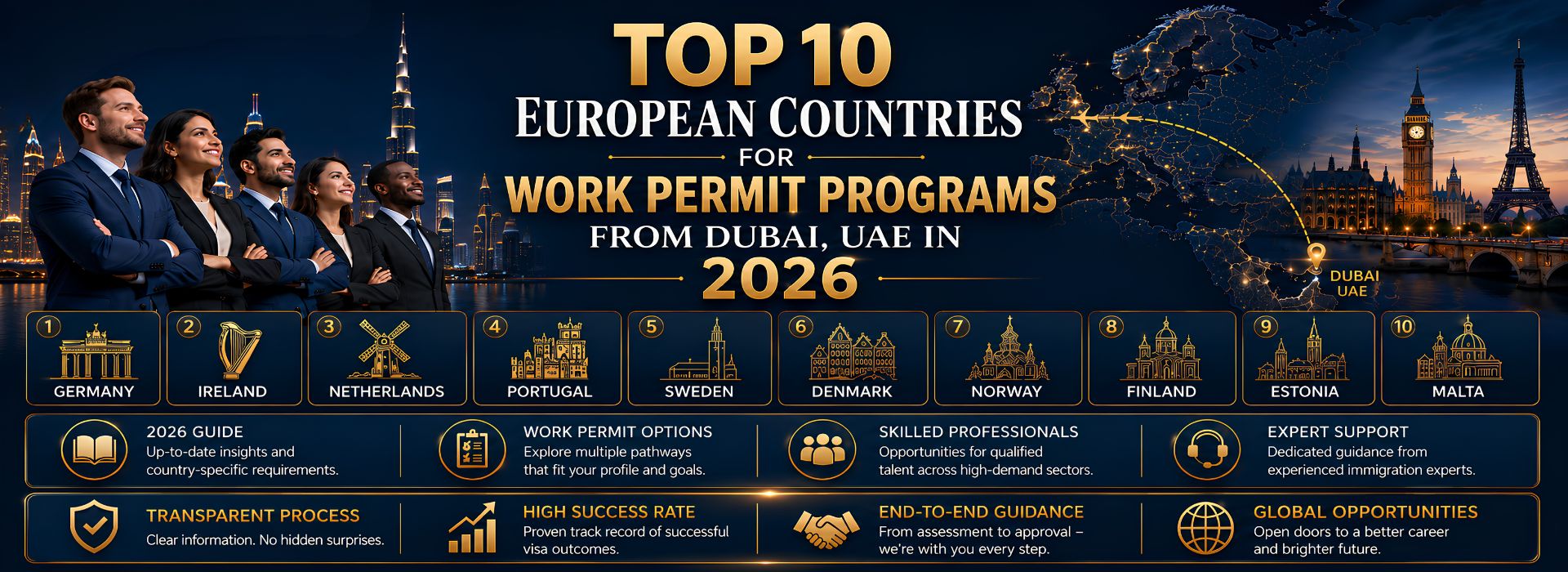
Are you searching for the best Europe work permit from Dubai in 2026?
For skilled professionals living in Dubai, Abu Dhabi and across the UAE, Europe continues to offer several employment based immigration pathways. However, there is an important point every applicant should understand before starting.
There is no single “Europe work permit.”
Each European country has its own immigration rules, salary requirements, occupation requirements and employer sponsorship procedures. The EU Blue Card provides a common framework for highly qualified workers in participating EU countries, but national requirements still apply.
Europe also continues to experience labour shortages. The European Labour Authority’s latest report, published in June 2026, found that shortages remain structural across several European labour markets. Healthcare and care occupations are particularly affected, while engineering, construction, technology and transportation also continue to experience skills gaps.
For UAE professionals, choosing the right country should therefore depend on your
- occupation
- qualifications
- professional experience
- salary level
- language ability
- licensing requirements
- availability of an eligible employer
- immigration pathway
This 2026 guide from The Global Axis Best Immigration Consultants compares ten European destinations worth exploring for UAE based professionals.
Important: This is an editorial comparison, not an official government ranking. Work permit eligibility depends on the individual applicant, employer, occupation and immigration rules in force when the application is submitted.
Quick Answer: Which European Countries Are Best for Work Permits from Dubai in 2026?
For skilled UAE residents, the European destinations worth evaluating include
- Germany
- Ireland
- Netherlands
- Denmark
- Austria
- Finland
- Sweden
- Norway
- Czech Republic
- Portugal
Germany stands out because it offers several skilled worker pathways, including the EU Blue Card, Skilled Worker Visa and Opportunity Card. Ireland remains particularly attractive for professionals whose roles qualify for a Critical Skills Employment Permit. The Netherlands, Denmark, Austria and Nordic countries also provide structured routes for qualified international workers.
Let us examine each destination.
1. Germany: One of the Strongest Skilled Work Routes in Europe
Germany remains one of the most important destinations to consider when searching for a work permit in Europe from Dubai.
The German immigration system provides several routes for qualified international professionals.
Major Germany Work Visa Options
These include
The EU Blue Card is particularly relevant for highly qualified professionals with an eligible employment offer.
For 2026, the standard EU Blue Card salary threshold is €50,700 gross per year. A reduced threshold of €45,934.20 applies to qualifying shortage occupations and certain new entrants to the labour market.
The German government also permits certain experienced IT professionals to qualify for the EU Blue Card based on professional experience, subject to the applicable requirements and salary threshold.
Germany Opportunity Card
Germany is especially interesting because the Opportunity Card can allow qualifying applicants to enter Germany to search for employment.
Applicants must meet qualification, eligibility and financial support conditions. For 2026, Germany indicates a financing benchmark of €1,091 net per month for the Opportunity Card.
This makes Germany different from many European work permit routes where an employment offer is normally required before the main work permit application.
Professionals Who May Explore Germany
Depending on current vacancies and qualification requirements:
- IT specialists
- engineers
- healthcare professionals
- technical professionals
- scientists
- manufacturing specialists
- construction professionals
- skilled tradespeople
Germany’s 2026 EU Blue Card shortage categories include several management, technology, STEM and healthcare related occupations.
Best suited for: Qualified professionals looking for multiple legal routes into the German labour market.
2. Ireland: Strong Option for Critical Skills Professionals
Ireland is another important destination for skilled professionals searching for an Ireland work permit from Dubai.
Two major employment permit categories are
Critical Skills Employment Permit
The Critical Skills Employment Permit is designed for occupations considered important to Ireland’s labour market.
Ireland introduced new employment permit salary thresholds on 1 March 2026.
The general minimum remuneration for many Critical Skills Employment Permit applications increased to €40,904, while different thresholds apply to certain categories and higher paid occupations.
Ireland also updated its Critical Skills Occupations List effective 13 May 2026.
General Employment Permit
The General Employment Permit covers a broader range of occupations, provided the position is eligible.
From 1 March 2026, the general salary threshold increased to €36,605, with separate rules applying to certain occupations and recent graduates.
Ireland also operates an Ineligible List. Applicants should therefore verify the occupation before assuming that a job offer will qualify for a permit. The current list took effect on 13 May 2026.
Professionals Who May Explore Ireland
Opportunities can be particularly relevant to applicants working in areas such as
- information technology
- healthcare
- engineering
- sciences
- construction related professional roles
- finance and specialised business functions.
Actual eligibility depends on the occupation code, salary, qualifications and employment offer.
Best suited for: Skilled professionals whose occupation appears on the Critical Skills list or otherwise qualifies for an employment permit.
3. Netherlands: Highly Skilled Migrant and EU Blue Card Routes
The Netherlands has one of Europe’s best known employer sponsored programs for highly skilled international employees.
The principal pathway is the Highly Skilled Migrant residence permit.
A key requirement is that the employer must normally be recognised as a sponsor by the Dutch Immigration and Naturalisation Service, or IND.
Netherlands Salary Requirements in 2026
For 2026, the monthly gross salary criteria excluding holiday pay include
- Highly Skilled Migrant age 30+: €5,942
- Highly Skilled Migrant under 30: €4,357
- Reduced criterion: €3,122
- EU Blue Card: €5,942
- Reduced EU Blue Card criterion: €4,754
Different eligibility conditions apply to each threshold.
The Netherlands also offers the European Blue Card. This can be attractive to qualifying highly educated professionals and can provide greater mobility within the EU Blue Card framework.
Suitable Profiles
The Netherlands can be particularly relevant to professionals in
- software and technology
- engineering
- finance
- data and analytics
- scientific research
- advanced technical occupations
- multinational corporate roles.
Best suited for: Experienced professionals who can secure an eligible position with a qualifying Dutch employer.
4. Denmark: Positive List Work Permit Pathways
Denmark operates several employment immigration pathways.
One of the most important is the Positive List system.
Denmark maintains separate lists for
- People with a Higher Education
- Skilled Work.
If an applicant receives an eligible employment offer for an occupation appearing on the appropriate Positive List and meets the related education requirements, they may qualify for a Danish residence and work permit.
Major 2026 Update
Denmark updated its Positive Lists on 1 July 2026.
The updated lists contained
- 164 job titles on the Positive List for People with a Higher Education
- 63 job titles on the Positive List for Skilled Work.
This is highly relevant for UAE professionals because applicants can directly compare their profession with occupations where Denmark has identified labour shortages.
EURES also reports shortages in Denmark across areas connected to technology, the green transition, biotech/pharma and healthcare.
Best suited for: Professionals whose education and occupation correspond with Denmark’s current Positive Lists.
5. Austria: Red White Red Card for Skilled Professionals
Austria offers a structured immigration framework through the Red White Red Card.
The system is designed for qualified third country nationals and includes several categories.
These include
- Skilled Workers in Shortage Occupations
- Very Highly Qualified Workers
- Other Key Workers
- graduates
- EU Blue Card applicants
- certain self employed and start up categories.
Skilled Workers in Shortage Occupations
A third country national may apply for a Red White Red Card as a skilled worker in a shortage occupation when the relevant qualification, employment and other requirements are satisfied.
The initial card can be valid for 24 months.
Austria publishes both nationwide and regional shortage occupation lists for 2026.
Austria’s points based model can consider factors such as qualifications, work experience, language ability and age depending on the specific route.
Best suited for: Engineers, technical professionals, healthcare workers and other qualified professionals whose occupations meet Austria’s current requirements.
6. Finland: Specialist Residence Permit
Finland provides a dedicated residence permit for specialists.
To qualify as a specialist, an applicant must have employment in Finland and duties requiring specialised expertise.
Specialists may include
- IT experts
- professionals with higher education
- specialists working in highly skilled positions
For 2026, the specialist salary must generally be at least €3,937 gross per month.
Finland also offers a broader residence permit for employed persons. For 2026, the general income floor for this route is €1,600 gross per month, while salary must also comply with the applicable collective agreement and other requirements.
These are different routes. Applicants should therefore select the permit category that actually corresponds with their job.
Best suited for: IT specialists, technical experts, engineers and other highly qualified professionals with Finnish employment offers.
7. Sweden: Updated Work Permit Rules in 2026
Sweden remains another potential destination for qualified foreign professionals.
However, applicants need to pay close attention to significant rule changes introduced in 2026.
From 1 June 2026, Sweden changed the salary requirement for many work permits.
As of 16 June 2026, the relevant median salary is SEK 38,300. This means the normal work permit salary requirement is at least SEK 34,470 per month, equal to 90% of the median salary.
Certain occupational groups are subject to an exemption under which a lower threshold of 75% of the median salary can apply.
Sweden also operates an EU Blue Card route. Since 15 July 2026, the Blue Card salary threshold is SEK 53,625 per month.
EURES identifies shortages in areas including healthcare, some IT roles, skilled construction work, manufacturing and transport within parts of Sweden.
Best suited for: Qualified professionals with compliant Swedish employment offers and salaries.
8. Norway: Skilled Worker Residence Permit
Norway is not an EU member, but it remains an important European destination for skilled professionals.
Its primary skilled worker residence permit can be applied for by applicants who have
- completed higher education
- completed qualifying vocational training
Applicants normally need an employment offer before applying.
The offered job must generally require skilled worker qualifications, and the applicant must possess the qualifications required for that position.
A particularly attractive feature is that qualifying skilled workers can potentially apply for permanent residence after three years, subject to meeting the permanent residence rules applicable at that time.
Norway also introduced additional employer confirmation measures in February 2026 for certain work applications submitted by applicants abroad. The measure is intended to reduce fraudulent job offers.
That is an important reminder for UAE applicants: always verify employment offers carefully before paying recruiters or intermediaries.
Best suited for: Qualified technical, professional and vocational workers who have secured genuine Norwegian employment.
9. Czech Republic: Employee Card and Blue Card
The Czech Republic offers the Employee Card, a combined long term residence pathway linked to employment.
Third country nationals can potentially obtain an Employee Card for different types of employment, subject to the applicable vacancy, employment and immigration requirements.
Employee Card holders without free labour market access generally need to work in positions recorded in the appropriate central database.
The Czech Republic also offers a Blue Card for highly qualified employment.
Official processing periods for Employee Card applications are generally listed as 60 days, extending to 90 days in particularly complex cases or where additional labour office input is required. Actual case timing can still vary.
Best suited for: Qualified applicants with Czech employment offers that meet Employee Card or Blue Card requirements.
10. Portugal: Employed and Highly Qualified Worker Routes
Portugal provides employment based immigration routes for non EU nationals.
For an employed worker residence visa, applicants can qualify based on circumstances including
- a signed employment contract
- a promise of an employment contract
- in certain cases, qualifications and applicable employment arrangements.
The precise requirements depend on the route being used.
Portugal also provides pathways for highly qualified workers. Applicants planning to undertake highly qualified work for longer periods generally require an appropriate residence visa before applying for their residence permit.
Portugal also participates in the EU Blue Card framework.
Applicants should be particularly careful when relying on older online information because Portugal revised elements of its immigration framework through changes that took effect in October 2025.
Best suited for: Professionals with genuine Portuguese job opportunities that satisfy the relevant employment and immigration conditions.
Europe Work Permit Countries Compared
| Country |
Important Work Route |
Job Offer Normally Required? |
Best Profile |
| Germany |
EU Blue Card / Skilled Worker / Opportunity Card |
Not always |
Skilled professionals |
| Ireland |
Critical Skills / General Employment Permit |
Yes |
Critical Skills professionals |
| Netherlands |
Highly Skilled Migrant / EU Blue Card |
Yes |
Highly skilled professionals |
| Denmark |
Positive List |
Yes |
Shortage occupation workers |
| Austria |
Red White Red Card |
Usually |
Skilled and shortage workers |
| Finland |
Specialist / Employed Person |
Yes |
Specialists and professionals |
| Sweden |
Work Permit / EU Blue Card |
Yes |
Skilled employees |
| Norway |
Skilled Worker Permit |
Normally |
Degree/vocational professionals |
| Czech Republic |
Employee Card / Blue Card |
Yes |
Skilled and general employees |
| Portugal |
Employment / Highly Qualified Worker |
Generally |
Professionals with employment |
Important: Requirements vary significantly by route. A work permit issued by one European country does not automatically give you permission to work in another European country.
Which Jobs Are in Demand in Europe in 2026?
The European Labour Authority’s latest labour shortage analysis confirms that shortages continue across European labour markets, although demand varies by country and region.
Healthcare and care occupations face especially persistent shortages. Wider European shortage areas also include occupations connected with
- engineering
- construction
- information technology
- transportation
- healthcare
- skilled trades
- tourism and hospitality
However, being in a shortage occupation does not automatically qualify someone for a visa.
The occupation must still satisfy the immigration rules of the destination country.
What Is the EU Blue Card?
The EU Blue Card is an employment and residence pathway for qualifying highly skilled non-EU nationals. Applicants generally need an eligible job offer or employment contract, appropriate qualifications or professional experience, and must satisfy the salary requirements of the participating country.
Applicants can review the official European Commission EU Blue Card information before selecting a destination.
The EU Blue Card framework operates in 25 of the 27 EU Member States. Ireland and Denmark do not participate in the EU Blue Card system and instead operate their own national skilled worker frameworks.
This is why an applicant should not search only for an “EU work permit.”
The correct pathway might instead be
- Germany EU Blue Card
- Netherlands Highly Skilled Migrant Permit
- Ireland Critical Skills Employment Permit
- Denmark Positive List
- Austria Red White Red Card
- Finland Specialist Permit
- Sweden Work Permit
- Czech Employee Card
- Norway Skilled Worker Permit
Can You Get a European Work Permit Without a Job Offer?
In most employment based European immigration programs, a genuine employment offer is required.
Germany is one of the important exceptions worth exploring.
The Germany Opportunity Card provides qualifying applicants with a pathway to enter Germany for job searching without first securing a permanent employment offer, provided they satisfy the applicable qualification, eligibility and financial requirements.
Do not assume that a “job seeker visa” exists in every European country.
Rules differ significantly.
How to Apply for a Europe Work Permit from Dubai
Although each country follows a different procedure, a typical process may involve the following stages.
Step 1: Profile Assessment
Review your
- age
- education
- occupation
- professional experience
- language ability
- professional licensing
- salary expectations
Step 2: Choose the Correct Country
Do not select a destination simply because someone claims its visa is “easy.”
Match your profile with the country’s actual immigration requirements.
Step 3: Verify Qualification Recognition
Some countries require academic or professional qualification recognition.
Regulated occupations such as healthcare can require additional professional licensing.
Step 4: Secure an Eligible Job Offer
For most European work permit programs, the applicant must have a genuine offer from an eligible employer.
Step 5: Verify the Employer
Check the employment contract, company and sponsorship eligibility.
Never rely solely on WhatsApp messages, social media advertisements or unofficial offer letters.
Step 6: Prepare Documents
Typical documents may include:
- passport
- UAE residence documentation
- employment contract
- educational certificates
- experience letters
- CV
- qualification recognition
- language results where applicable
- police or medical documentation when required
- financial evidence where applicable
Step 7: Submit the Correct Work and Residence Application
Depending on the country, the employer, employee or both may participate in the application.
Step 8: Complete the Entry Visa Procedure
Approval of employment permission does not always mean that all entry requirements are complete.
Applicants may still need the appropriate national entry visa or residence procedure.
How to Choose the Best European Work Permit Country from the UAE
Instead of asking
“Which European country gives the easiest work visa?”
Ask
“Which European work permit pathway matches my occupation, qualifications, experience and salary?”
That is a much more useful question.
For example
Choose Germany if:
You are a qualified professional exploring the EU Blue Card, skilled worker routes or Opportunity Card.
Choose Ireland if:
Your profession may qualify under the Critical Skills or General Employment Permit framework.
Choose the Netherlands if:
You can secure a highly skilled role with a qualifying sponsor.
Choose Denmark if:
Your occupation appears on the current Positive List.
Choose Austria if:
Your profession aligns with the Red White Red Card system or a shortage occupation.
Choose Finland if:
You are working in a specialist or highly skilled position.
Choose Sweden if:
You have a compliant employment offer that meets the current salary and immigration rules.
Choose Norway if:
You have recognised skilled qualifications and a qualifying Norwegian employment offer.
Common Mistakes UAE Applicants Should Avoid
1. Believing There Is One Europe Work Permit
Every country operates its own immigration system.
2. Paying for an Unverified Job Offer
Work permit fraud remains a serious risk.
Norway’s introduction of extra employer confirmation measures in 2026 illustrates how authorities are strengthening safeguards around job offers.
3. Checking the Salary but Ignoring the Occupation
Salary alone may not establish eligibility.
4. Ignoring Qualification Recognition
This is particularly important in regulated professions.
5. Using Outdated 2024 or 2025 Information
Several European countries changed immigration rules during 2026.
Ireland changed salary thresholds on 1 March and occupation lists on 13 May. Denmark updated its Positive Lists on 1 July. Sweden introduced significant salary rules from 1 June.
6. Common Mistakes UAE Applicants Should Avoid
Applicants who still have questions about work permits, skilled migration, eligibility or documentation can visit our Immigration Frequently Asked Questions.
Why Consider Professional Europe Work Permit Guidance in Dubai?
European immigration procedures can involve several separate requirements
- occupation eligibility
- employer verification
- qualification recognition
- salary thresholds
- work authorisation
- residence applications
- embassy requirements
- supporting documentation
The Global Axis Immigration Services provides work permit and skilled migration guidance for applicants based in Dubai and the UAE. Its website already maintains dedicated resources covering European work permits, skilled migration and Ireland skilled migration.
A professional profile assessment can help identify which pathway should be investigated before an applicant commits time and money to a particular country.
Frequently Asked Questions About Europe Work Permits from Dubai
1. Which European country is best for a work permit from Dubai?
There is no single best country for every applicant. Germany is particularly flexible because of its EU Blue Card, Skilled Worker Visa and Opportunity Card. Ireland, the Netherlands, Denmark, Austria and Nordic countries also have structured pathways. The best option depends on your occupation, qualifications, salary and employment offer.
2. Can UAE residents apply for a European work permit?
Yes. UAE residents can apply for European work and residence pathways when they satisfy the immigration conditions and the relevant embassy or consular jurisdiction requirements. The exact application process depends on nationality, UAE residence status and destination country.
3. Can I get a European work visa without a job offer?
Most employment based European pathways require a job offer. Germany’s Opportunity Card is an important exception for qualifying job seekers because it can allow applicants to enter Germany to search for suitable work after meeting the applicable requirements.
4. What is the easiest European country to get a work permit?
There is no universally “easiest” country. Eligibility depends on your occupation, qualifications, experience, employer and salary. Applicants should compare their profile against official immigration criteria rather than selecting a country based on advertising claims.
5. Which jobs are most in demand in Europe?
Europe continues to experience shortages across healthcare and care services, while shortages also affect engineering, construction, ICT, transportation and several skilled occupations. Demand varies considerably between countries.
6. What is the EU Blue Card?
The EU Blue Card is a residence and employment pathway for qualifying highly skilled non EU nationals. Eligibility normally involves professional qualifications or skills, an eligible employment contract or binding offer and a country specific salary threshold. It applies across 25 EU Member States.
7. Does an EU Blue Card let me work anywhere in Europe?
No. An EU Blue Card is issued by a specific participating EU country. It can provide mobility advantages under EU rules, but it does not mean an applicant automatically has unrestricted employment rights throughout Europe.
8. How much salary do I need for a Germany EU Blue Card in 2026?
For 2026, Germany’s normal EU Blue Card salary threshold is €50,700 gross annually. A reduced threshold of €45,934.20 applies in qualifying shortage occupations and certain other eligible cases.
9. What is Ireland’s Critical Skills salary requirement in 2026?
From 1 March 2026, the standard threshold for many Critical Skills Employment Permit applications increased to €40,904. Different thresholds apply to specific categories, so applicants should check the exact occupation and permit criteria before applying.
10. Do I need IELTS for a Europe work permit?
There is no single Europe wide IELTS requirement. Language requirements depend on the country, occupation, employer and professional regulator. Some employment pathways do not impose an IELTS requirement, while regulated professions can require proof of local language or professional language competence.
Final Thoughts: Which Europe Work Permit Should You Choose in 2026?
Europe continues to provide valuable career opportunities for international professionals, but choosing the right immigration route requires more than selecting a popular country.
Your occupation, qualifications, experience, salary, employer and long term career plans should guide the decision.
Germany may suit professionals seeking flexible skilled worker options. Ireland can be highly relevant for Critical Skills applicants. The Netherlands focuses heavily on sponsored highly skilled workers. Denmark uses shortage based Positive Lists, while Austria operates its Red White Red Card system.
The correct strategy is therefore
Assess your profile first. Choose the country second. Apply under the correct immigration pathway third.
If you are living in Dubai, Abu Dhabi or elsewhere in the UAE and are considering a Europe work permit, The Global Axis Immigration Services can help you review potential pathways and understand the documentation and eligibility requirements that may apply to your profile.
Start with a professional profile assessment before choosing your European destination.