A practical guide for Dubai and UAE residents | Information checked: 13 November 2026
The best countries for physiotherapists offer a workable combination of professional registration, suitable employment, realistic immigration options and a future for your family. For physiotherapists living in Dubai, choosing a destination starts with understanding how those requirements fit your own qualifications and experience.
Your UAE clinical experience can strengthen an application, but each destination assesses your education, professional standing and language skills separately. A DHA, Department of Health Abu Dhabi or MOHAP licence does not automatically authorise practice overseas.
This 2027 planning guide from The Global Axis Immigration Services LLC compares ten destinations using current regulator, immigration and salary sources. Salary figures are dated benchmarks, and future policy changes must be checked before applying.
Quick answer: which are the best countries for physiotherapists in 2027?
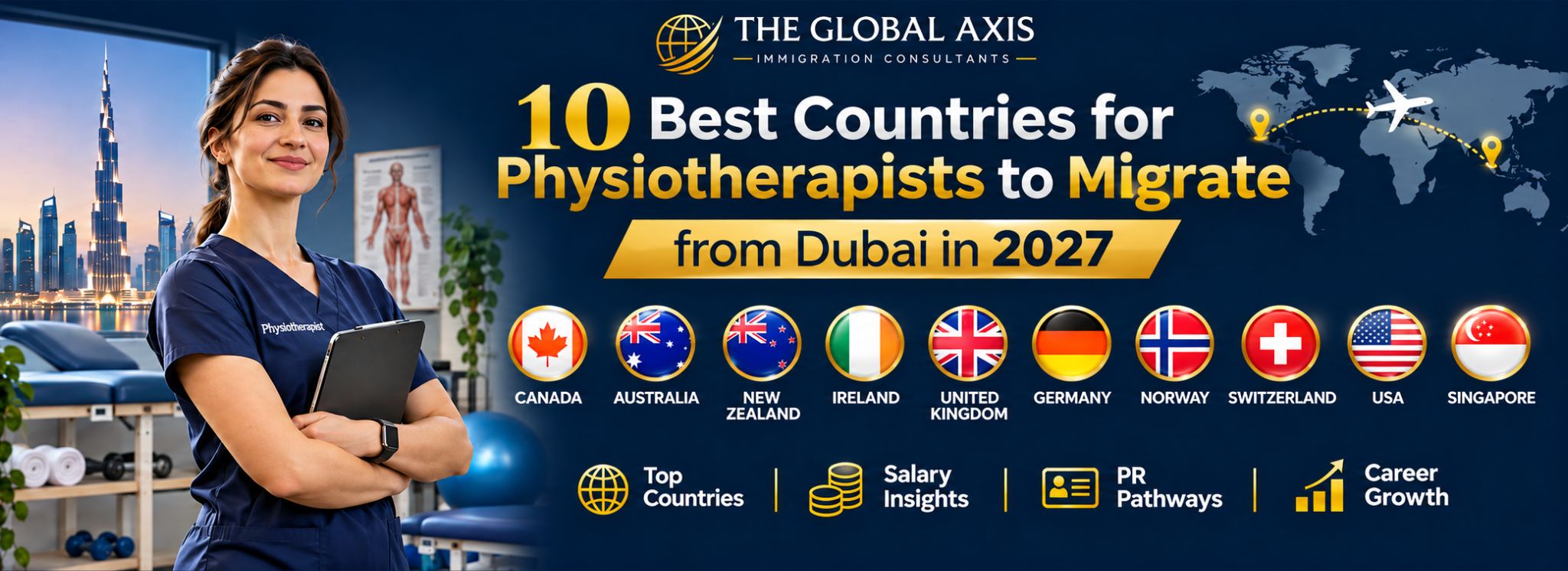
Australia, New Zealand, Canada, Ireland, the United Kingdom, Germany, the United States, the Netherlands, Sweden and Norway are worth comparing.
For English-speaking applicants, start with Australia, New Zealand, Canada, Ireland and the UK. New Zealand has a potential direct residence route for qualifying physiotherapist job offers. Australia and Canada offer routes that may lead directly to permanent residence for eligible, selected applicants. Germany and the Nordic countries deserve closer attention if you can invest in local-language training.
This is an editorial shortlist based on registration, immigration options, pay evidence and family considerations. It is not an official ranking or a prediction of visa approval.
Best countries for physiotherapists: salary comparison
All figures below are gross, before tax. Public pay scales, career-profile ranges, wage percentiles and individual vacancies describe different parts of each market. They are not uniform national salary ranges or confirmed 2027 offers.
| Country | Salary benchmark | What the figure represents |
|---|
| Australia | AUD 83,824–120,740 a year | Queensland Health HP3 pay points 0–7, effective September 2026; a public-sector benchmark. Source |
| New Zealand | NZD 79,014–119,300 a year | Salary band advertised in a Health New Zealand physiotherapist vacancy listed 13 November 2026; confirm full-time equivalent and appointed step. Source |
| Canada | CAD 30.00–56.21 an hour | Job Bank national low–high wages; median CAD 46.15/hour. Updated November 2025, using 2023–2024 data. Source |
| Ireland | EUR 45,514–65,068 a year | HSE staff physiotherapist scale, effective June 2026. Senior and specialist grades have separate scales. Source |
| United Kingdom | GBP 32,000–48,000 a year | National Careers Service starter-to-experienced guide; actual NHS pay depends on grade and location. Source |
| Germany | EUR 2,928–4,062 a month | Federal Employment Agency lower-to-upper quartiles; median EUR 3,452/month in the retrieved national table. Source |
| United States | USD 77,140–135,140 a year | BLS 10th-to-90th percentile thresholds, May 2025; median USD 102,760. Earnings extend below and above these thresholds. Source |
| Netherlands | EUR 3,993–5,845 a month | An advertised UMC Utrecht oncology physiotherapist scale, based on 36 full-time hours, November 2026. This is an experienced specialist example. Source |
| Sweden | SEK 34,700–41,800 a month | SCB 2025 lower-to-upper quartiles for physiotherapists employed in the regional-government sector; median SEK 38,300. Source |
| Norway | NOK 522,000–629,000 a year | Published Spekter physiotherapist minimum scale from zero to ten years of seniority, effective May 2026. Local additions may apply. Source |
For perspective, Canada’s hourly range equates to approximately CAD 62,400–116,917 annually if paid for 40 hours a week over 52 weeks. This is a calculation, not a guaranteed annual salary.
When comparing countries for physiotherapists, calculate take-home pay after tax, rent, transport, professional fees, insurance and childcare. A larger gross salary does not establish how much your household will save compared with your Dubai income.
1. Australia: skilled migration and permanent residence options
Australia is a useful starting point for physiotherapists comparing skilled migration with employer sponsorship. Highlight experience relevant to hospital rehabilitation, musculoskeletal practice, aged care and community services when reviewing vacancies.
Professional registration: Check the Australian Physiotherapy Council’s assessment pathways, followed by Physiotherapy Board of Australia registration through Ahpra. The applicable route depends on your education and registration history. A migration skills assessment has its own requirements.
PR opportunities: Physiotherapist, ANZSCO 252511, appears on the Home Affairs skilled occupation list. Depending on eligibility, consider subclasses 189 and 190, which grant permanent residence, or the provisional regional subclass 491 with a potential later pathway to subclass 191. Points-tested applicants generally need an invitation before turning 45. Meeting minimum points does not guarantee selection.
Family: Eligible partners and dependent children can be included under the relevant visa’s family rules. Work, study and healthcare conditions should be checked for the visa granted.
Explore Australia skilled migration from Dubai.
2. New Zealand: a potential direct residence route
New Zealand is particularly relevant if you can obtain professional registration and a qualifying offer from an accredited employer.
Professional registration: Apply through the appropriate Physiotherapy Board of New Zealand pathway, then obtain the practising certificate required for clinical work.
Residence opportunities: Physiotherapist is listed in Tier 1 of the Green List. The Straight to Residence Visa may suit applicants aged 55 or younger who meet the role, accredited-employer, registration, English, health and character requirements.
This resident visa allows indefinite residence. A Permanent Resident Visa is a later, separate application, generally available after holding residence for at least two years and meeting the relevant conditions.
Family: An eligible partner and dependent children aged 24 or younger can be included in the residence application. Check dependency and relationship requirements.
Clinical experience to highlight: Rotational hospital work, outpatient musculoskeletal care, community rehabilitation and older-adult services, according to the vacancy.
Read about New Zealand skilled migration from Dubai.
3. Canada: healthcare selection and provincial licensing
Canada is worth assessing for physiotherapists whose qualifications, language results, experience and overall immigration profile are competitive.
Professional registration: Review CAPR’s current credentialling pathways, its Canadian Physiotherapy Examination requirements and the rules of your intended provincial or territorial regulator. An immigration Educational Credential Assessment serves a different purpose from clinical licensing.
PR opportunities: Physiotherapists, NOC 31202, are included in the Express Entry healthcare and social services category. Current category rules require at least 12 months of eligible experience within the preceding three years, alongside eligibility for an Express Entry program and the applicable round. Candidates still compete for invitations. A suitable provincial nomination may be another option.
Family: Eligible spouses or partners and dependent children can accompany a successful PR application. Declare all required family members. For temporary workers, a spouse’s open work permit depends on separate eligibility; the usual high-skilled-worker route includes a remaining-work-authorisation requirement of at least 16 months.
Compare Canada PR and skilled migration options from Dubai.
4. Ireland: Critical Skills and family reunification
Ireland combines English-language clinical practice with an employment-permit route that specifically includes physiotherapists.
Professional registration: International qualifications must be assessed through the relevant CORU recognition process, followed by professional registration. Additional measures may be required if training gaps are identified.
Immigration and settlement: Physiotherapists appear on the Critical Skills Occupations List. A Critical Skills Employment Permit normally requires an eligible two-year job offer and the applicable qualification and salary conditions.
Eligible CSEP workers may seek a Stamp 4 upgrade after 21 months from starting qualifying employment in Ireland. Stamp 4 is renewable immigration permission. Long-term residence and citizenship have separate rules.
Family: CSEP holders can apply for immediate family reunification, subject to approval. An eligible spouse or de facto partner granted Stamp 1G can work without a separate employment permit; self-employment is restricted under that permission.
Salary progression: June 2026 HSE scales show EUR 65,197–76,767 for senior physiotherapists, above the staff scale in the comparison table.
Explore Ireland skilled migration from Dubai.
5. United Kingdom: sponsored healthcare employment
The UK is a practical option to research if your priority is an English-speaking healthcare role with an eligible sponsoring employer.
Professional registration: Overseas applicants must meet the Health and Care Professions Council’s international registration requirements, including the applicable education, competence and English standards.
Immigration and settlement: Physiotherapists can qualify for the Health and Care Worker visa through an eligible job with an approved sponsor, a Certificate of Sponsorship and the required salary and other conditions. Current published guidance provides for possible indefinite leave to remain after five qualifying years. Recheck the rules in force for a 2027 application.
Family: Eligible partners and children can apply as dependants. A granted dependant partner can generally work and study. Check the rules for the physiotherapist occupation rather than applying restrictions written for other care-sector roles. Qualifying Health and Care Worker applicants and dependants are exempt from the immigration health surcharge.
Clinical experience to highlight: Rotational services, neurological rehabilitation, respiratory care, musculoskeletal practice and community work, matched to the advertised post.
Review UK skilled migration guidance from Dubai.
6. Germany: rehabilitation careers with German-language preparation
Germany deserves consideration if you are prepared to build the language skills needed for patient care and complete professional recognition.
Professional registration: Physiotherapy is regulated. Use the official Recognition Finder to identify the relevant authority and procedure. German at B2 level is a key requirement in the cited physiotherapist recognition procedure. The responsible state authority determines equivalence and any additional measures.
PR opportunities: A recognised qualification, professional authorisation and suitable employment can support an eligible skilled-worker residence route. Under current rules, qualifying skilled workers may obtain a settlement permit after three years, with conditions including 36 months of pension contributions, financial self-support, German-language ability and other requirements.
Family: Spouses and children may qualify for family reunification. A spouse’s approved family residence permission can allow employment.
Clinical experience to highlight: Orthopaedic rehabilitation, neurological recovery, outpatient treatment and older-adult mobility services. The recognition process and German-language readiness should guide your timetable.
7. United States: strong earnings with substantial licensing work
The United States offers a large physical therapy market. BLS projects employment growth of 12% from 2025 to 2035, but that projection does not establish an individual applicant’s visa eligibility.
Professional registration: Select the state where you intend to practise, then review foreign-educated physical therapist requirements. These may involve education equivalency, the NPTE, English evidence and state-specific conditions. Separately, check healthcare-worker certification for immigration. A BPT alone should not be assumed sufficient; additional education may be necessary.
PR opportunities: Physical therapists are included in Schedule A, Group I. An eligible employer-sponsored immigrant petition may support permanent residence, subject to licensing evidence, petition requirements and immigrant-visa availability. Waiting periods depend partly on the relevant preference category and country of chargeability, usually linked to birthplace.
Family: A spouse and eligible unmarried children under 21 may seek derivative immigrant visas. Family work rights under temporary visas require a separate assessment.
Clinical experience to highlight: Outpatient rehabilitation, hospital care, home health and older-adult rehabilitation.
8. Netherlands: Dutch proficiency and employer eligibility matter
The Netherlands may suit applicants ready to develop Dutch-language clinical communication and complete qualification recognition.
Professional registration: Foreign physiotherapy qualifications require the appropriate recognition procedure and BIG registration. The published Dutch-language requirement for physiotherapists is B2. Further requirements depend on the diploma and route.
PR opportunities: Non-EU applicants need a suitable immigration basis. An employer may need a combined residence and work permit, or GVVA. A highly skilled migrant route is only suitable if its sponsor and salary conditions are met. Under current rules, permanent residence may be possible after five qualifying years, subject to the IND’s additional conditions.
Family: Partner and child applications are possible where conditions are met. Partner work rights vary: a highly skilled migrant’s partner is generally free to work, while the partner of a GVVA holder generally needs an employer with a separate work permit.
Clinical experience to highlight: Rehabilitation, hospital services and relevant specialist practice. The salary example above is specifically for an experienced oncology role.
9. Sweden: a longer preparation route for non-EU graduates
Sweden can be considered by physiotherapists prepared for Swedish-language training and a potentially substantial licensing process.
Professional registration: Apply through Socialstyrelsen’s route for applicants educated outside the EU/EEA where applicable. It includes qualification assessment and further steps such as proficiency testing, Swedish-law training and clinical practice. Accepted language evidence includes Swedish at C1 level or a recognised equivalent. The regulator says the overall route usually takes two to four years.
PR opportunities: A qualifying job must meet the work-permit rules in force, including applicable pay and employment conditions. Under the current standard employee route, applicants may seek permanent residence after qualifying work for four of the preceding seven years, subject to income, conduct and other conditions.
Family: Eligible family members can apply to accompany or join a worker, subject to maintenance requirements. Approved family residence permission can allow a partner to work.
Clinical experience to highlight: Community rehabilitation, hospital practice and older-adult care. Build language and registration preparation into your plan before setting a relocation date.
10. Norway: authorisation before a skilled-worker move
Norway is another option for physiotherapists willing to develop local-language proficiency and complete the professional authorisation process.
Professional registration: Review Norwegian authorisation requirements. Applicants trained outside the EU/EEA generally face additional requirements, including Norwegian at B2 level or accepted equivalent documentation and the relevant national-subject requirements. Individual education assessments determine the applicable steps.
PR opportunities: A suitable job and the required qualifications and authorisation can support a skilled-worker residence application. Qualifying residence can lead to a permanent-residence application after three years, provided the applicable residence, income, language and other requirements are met.
Family: Eligible family members can usually apply to live with a skilled worker. Confirm your partner’s employment conditions on the family permission granted.
Clinical experience to highlight: Municipal rehabilitation, hospital services, neurological care and older-adult mobility. Published minimum pay scales differ from individual offers, which may include local additions.
Which physiotherapy skills should you highlight?
Clinical specialisms can help you match an employer’s needs. The following are useful areas to research, rather than a claim that every country has formally designated each one a shortage occupation.
| Clinical area | Evidence to include in an application |
|---|
| Musculoskeletal and orthopaedic rehabilitation | Outpatient caseload, postoperative rehabilitation, assessment and treatment planning |
| Neurological rehabilitation | Stroke, spinal injury or other neurological caseload experience, with relevant training |
| Older-adult and community rehabilitation | Falls prevention, mobility assessment, home visits and multidisciplinary care |
| Cardiorespiratory physiotherapy | Relevant inpatient, respiratory or critical-care rotations and competencies |
| Paediatric physiotherapy | Relevant supervised experience, child-development knowledge and safeguarding training |
| Sports and specialist rehabilitation | Appropriate qualifications, rehabilitation planning and evidence relevant to the advertised role |
Use accurate, anonymised case summaries. Keep patient-identifying information out of CVs, portfolios and marketing material.
How to apply from Dubai through The Global Axis
You can make the process easier to manage by setting out the registration, employment and immigration steps before choosing a package or destination.
Step 1: Request a profile assessment
Share your age, nationality, country of birth, qualification, country of training, clinical experience, current professional registration, language results and family plans. UAE residence is useful application context; destination eligibility also depends on your personal circumstances.
Step 2: Shortlist two or three countries
The most suitable countries for physiotherapists depend on registration feasibility, job-offer requirements, immigration eligibility, family needs and total cost. Ask The Global Axis which destinations and services are currently covered by its team or professional partners.
Step 3: Prepare your professional documents
Start with your passport, UAE residence documents, degree, transcript, detailed syllabus, internship and clinical-placement records, professional licences, certificates of good standing, employment references and language evidence. Obtain translations or verification in the format requested by the receiving authority.
Step 4: Complete the applicable assessments
Professional registration, migration skills assessments and immigration education assessments can serve separate purposes. Follow the correct sequence for your destination. Some steps can run in parallel; others require an earlier approval.
Step 5: Progress the job or selection route
Employer-led routes usually require an eligible offer and, where applicable, sponsorship. Points-based routes may require an expression of interest, nomination or invitation. A job-search service cannot determine a regulator’s or immigration authority’s decision.
Step 6: Prepare the family and relocation plan
Review partner work rights, children’s permissions and schooling, health coverage, housing and the documents proving your relationships. Budget for tests, assessments, examinations, visas, medicals, police certificates and relocation, alongside any consultancy fees.
Step 7: Confirm the written scope before proceeding
Request an itemised service agreement showing responsibilities, professional partners where needed, fees, exclusions and refund terms. Ask for realistic milestones based on your licensing position and selected route.
Start with a free profile assessment from The Global Axis in Dubai.
FAQs: countries for physiotherapists and applications from Dubai
Which are the best countries for physiotherapists seeking PR?
New Zealand, Australia and Canada are useful starting points. New Zealand requires a qualifying offer for its Green List residence route; Australia and Canada assess applicants through their respective eligibility and selection systems. The strongest choice depends on your registration prospects and overall profile.
Can a DHA-licensed physiotherapist work overseas immediately?
An overseas regulator must first confirm your right to practise under its rules. A DHA licence and UAE experience can support your professional record, but destination registration and the required immigration permission remain necessary.
Is a BPT degree accepted for physiotherapist migration?
It depends on the destination’s assessment of your university, curriculum, clinical training and other evidence. Some applicants need examinations, supervised practice, additional study or other measures. Check both professional licensing and immigration requirements before enrolling in further education.
Is IELTS compulsory for physiotherapists moving abroad?
English-speaking destinations require acceptable evidence of English, but accepted tests and exemptions differ between regulators and visa routes. Some accept alternatives to IELTS. Germany, the Netherlands, Sweden and Norway also require relevant local-language proficiency for the registration pathways described here.
Can I migrate without an overseas job offer?
Certain Australian points-tested visas and Canadian Express Entry pathways can be possible without a job offer, if you meet the relevant criteria and are selected. New Zealand’s Straight to Residence route requires qualifying employment or an offer. Employer-led work routes require a suitable employer.
Can my spouse and children join me?
Many of these routes allow eligible family members to apply. Dependency, age, relationship, maintenance and permission rules differ. Your spouse’s right to work and your family’s healthcare or schooling arrangements should be checked for the specific status granted.
Which country pays physiotherapists the highest salary?
The US BLS benchmark shows a median annual wage of USD 102,760 in May 2025. This does not establish a universal worldwide ranking. Compare equivalent roles, exchange rates, tax, living costs, hours and registration expenses before judging an offer.
Does Ireland’s Stamp 4 mean permanent residence?
Stamp 4 is renewable immigration permission that can allow work without an employment permit. Eligible Critical Skills workers may qualify after 21 months of qualifying employment. Long-term residence and citizenship require separate assessments.
How long does physiotherapist migration take?
The total includes document verification, language preparation, professional assessment, any examinations, recruitment and immigration processing. Each stage has a different timetable. For example, Sweden’s regulator describes a usual two-to-four-year route for the relevant non-EU/EEA licensing process. Ask for a plan specific to your profile.
How can The Global Axis help me start from Dubai?
Request a profile assessment and a written outline of the available support for your shortlisted destination. Bring your CV, qualifications, registration details, language results and family information so the team can discuss relevant pathways and next steps.
Ready to compare countries for physiotherapists with your own goals in mind? Contact The Global Axis to discuss a practical plan for 2027.
This article provides general planning information. Professional regulators, employers and immigration authorities assess applications independently. Requirements and published pay figures can change.